Showing posts with label Video Games. Show all posts

09 September, 2023

Islets & Islanders—An All-Accommodating Getaway Package

Even if I took this photo in mid-May, I enjoy having an early sunrise in the summertime. Not so much the late sunsets though for some reason. —Taken with an iPhone 8 

Summer and I do not exactly get along. Sure, there may be more opportunities for adventure and spectacle with a local fireworks show—unrelated to US Independence Day—but it is the extensive heat that sours what is otherwise a low-key season. Walks were something I would usually avoid in summer more or less because, well, I usually end up in a aura of moisture about ten to fifteen minutes in—sometimes after I make it across the street. While it might be a bit of bummer, the little things like a Dairy Queen Blizzard treat,  or going to a family reunion at a lake house make the season worthwhile. The ideal summer image of a tropical island vacation also sounds promising with two games making up a vacation package of easy-going fun.

One of many quirky and lovable characters who reside in the sky islands. —Captured on Switch (Handheld Mode) 

The first stop in this vacation cruise is a journey to the skies where a chain of once-connected islands lies scattered across the clouds in Islets—a game developed by Kyle Thompson for Armor Games Studios. The official website describes the game as “A Surprisingly Wholesome Metroidvania” and, while I think it fits the adventure to a tee, it also does not do the game proper justice. Even if I was alternating between this game and Tears of the Kingdom back in June, I found Islets to be a vibrant and refreshing change of pace. This starts with our main character, a warrior mouse named Iko, who sets forth on a journey to join the sky islands together again and he is far from alone as a competing warrior, an overzealous show-off named Snoot, manages to tear down Iko’s boat by merely revving his own airship. Once Iko crashes onto the lush green plains of Northstable Island, his quest truly begins with a simple tutorial and some low-fi beats from the game’s composer, Eric Thompson.

The controls are very easy to get the hang of—even if I sometimes forgot I could do forward rolls—and the power ups are the usual standard metroidvania fare. Players familiar with Hollow Knight will recognize the double jump and Islets's own approach to wall-clinging abilities where Iko can just climb straight up to the top. When Islets does its own thing, though, it does so it a cool fashion from arrows that can create contrails for platforms to airship boss fights which feel like something out of Cotton, Darius, or Turrican. 

The big innovator which fully gives Islets that refreshing change of pace is the exploration itself. While Iko might not have the expansive move set of someone like the Knight, the act of reconnecting the islands acts a series of power-ups to encourage backtracking. Each time I added an island back to the chain, the journey back through them almost felt like new with additional pathways sandwiched between adjacent ares instead of a mere trek around the map. The visuals themselves, while not as detailed as Hollow Knight or Monster Boy and the Cursed Kingdom, still breath life into the aerial archipelago and the characters who fly about them and the hub town, Sky City. If the links between islands are like powers-ups, the characters and how they develop act as pieces of lore, in which denizens tell Iko about landmarks and points of interest.

An unexpected highlight of Islets, which puts some arcade-like action into a Metroidvania. —Captured on Switch (Handheld Mode)  

Even for a game that makes simplicity shine in everything from world-building and character development to gameplay, there are some rough patches of turbulence—mostly in the form of boss battles. While I found it really cool that said bosses and normal enemies had projectiles that were easy to see—and simple tells of attack prep with a few exclamation marks—the big behemoths felt like they took forever to defeat. Even if these fights get tedious after awhile, the sword-fighting does not feel out of place. The variations between the difficultly levels are not much to write home about either—the more difficult the setting, the stronger the foes are. They also develop more complex bullet patterns between each tier, but it feels more subtle with the most notable difference being in the first boss’s second phase with both easy and normal modes being completely identical.   

The last little niggle deals with Islets own version of health and ammo bonuses—a roulette of additional perks which range from the afermentioned to adding extra power to every other attack and in-game currency you can use in Sky City for other perks. This is another one of Islets’s neat twists to the metroidvania formula and most of them are not that difficult to obtain. The ones that pose some trouble seldom require extreme coordination or reflexes, making Islets easy to fully complete. As for the rewards, even if there is a choice whether to play it safe with a health increase or risk it for gold, the variety in choice sometimes varies greatly. The incremental increases offered both with said pickups and the Sky City stores might prompt players continuously go for the former, but considering how easy it is to gain funds, there is some breathing room. 

Islets might lack the palm trees of a tropical beach resort in both in the literal and figurative sense, but it is still a metroidvania that manages to both accommodate newcomers and challenge the pros simultaneously.

This island reminded me of Windwaker while I was building the mills and cities. I couldn't help but think of Windfall Island. —Captured on Switch (Handheld Mode)

The next destination is a proper cruise from one island to the next where the cities, tourist attractions, and even the agriculture turn the vacationer to a full-time construction worker in Islanders—an indie game developed by Grizzly Games. Unlike the intense focus on finances, budgeting, and proper zoning in similar titles like Sim City, Islanders focuses more on just developing the procedurally-generated islands into livable spaces while aiming for a high score. Each island requires a certain amount of development and points before the player can start an expedition to the next one and the key to a quick getaway is, well, zoning by building type. Each building can benefit from either adjacent structures—like mills and fields—or by the surrounding resources, which can significantly bolster the score. Even if a player reaches the expedition cap, they can still continue to further develop the island with fountains, parks, and towers among other options. 

Even if the sessions can be short—usually between one to two hours—Islanders has quite a bit of depth with its gameplay with situations that require some out-of-the-box thinking. There may be islands where the game provides you with multiple wooden piers (or plateaus) in order to make up for the lack of land mass. Some locales might even provide you with major buildings and exclude the smaller producers—think sawmills without lumberjacks or mills without fields. Even particular buildings like the Shaman’s Hut involve some pixel-perfect placement to get the highest amount of points possible, and to make up for the reduction if there is a mansion nearby. 

This deceptively simple gameplay loop kept me enthralled with Islanders with each session I played while the 3D visuals and music evoked that relaxing island atmosphere. There are both tropical and snowy islands alongside many interesting geographic variations which help keep the game fresh. For those who just want to get creative, the game also includes a “sandbox mode” that takes the scoring system out completely. Both modes make Islanders into a game that embraces the best aspects of summer—a laid-back day at the resort with a crossword puzzle and piƱa colada. (Other drinks are available.)     


Top: Another one of my favorite builds in Islanders, featuring some of the 
Bottom: A tour guide contemplates a price hike in Islets. —Both Captured on Switch (Handheld Mode) 

From sky back to the seas, the full vacation package contains a duo of pick-up-and-play titles that manage to balance both challenge and difficultly. Islets might have boss fights that feel like in-flight delays, but the journey across and between the sky islands provides a fresh take on metroidvanias for veterans and newcomers alike. The follow-cruise with Islanders suffers the opposite problem with (sometimes) short sessions, but the gameplay is engrossing enough to keep the momentum. Whether you are big into metroidvanis or want the therapeutic experience of constructing an island city without noise pollution, this vacation package has you covered! 


Islets In Sum: Brave Mouse Discovers New Technology. Epic Monsters Still Rampant: 8.5 out of 10 

Islanders In Sum: Urban Development at Its Ideal (Albeit Brief)—Tranquil and Deceptively Easy: 9.5 out of 10 

02 September, 2023

Goldeneye 007: The Making of an N64 Classic—Gaming Memories are Forever

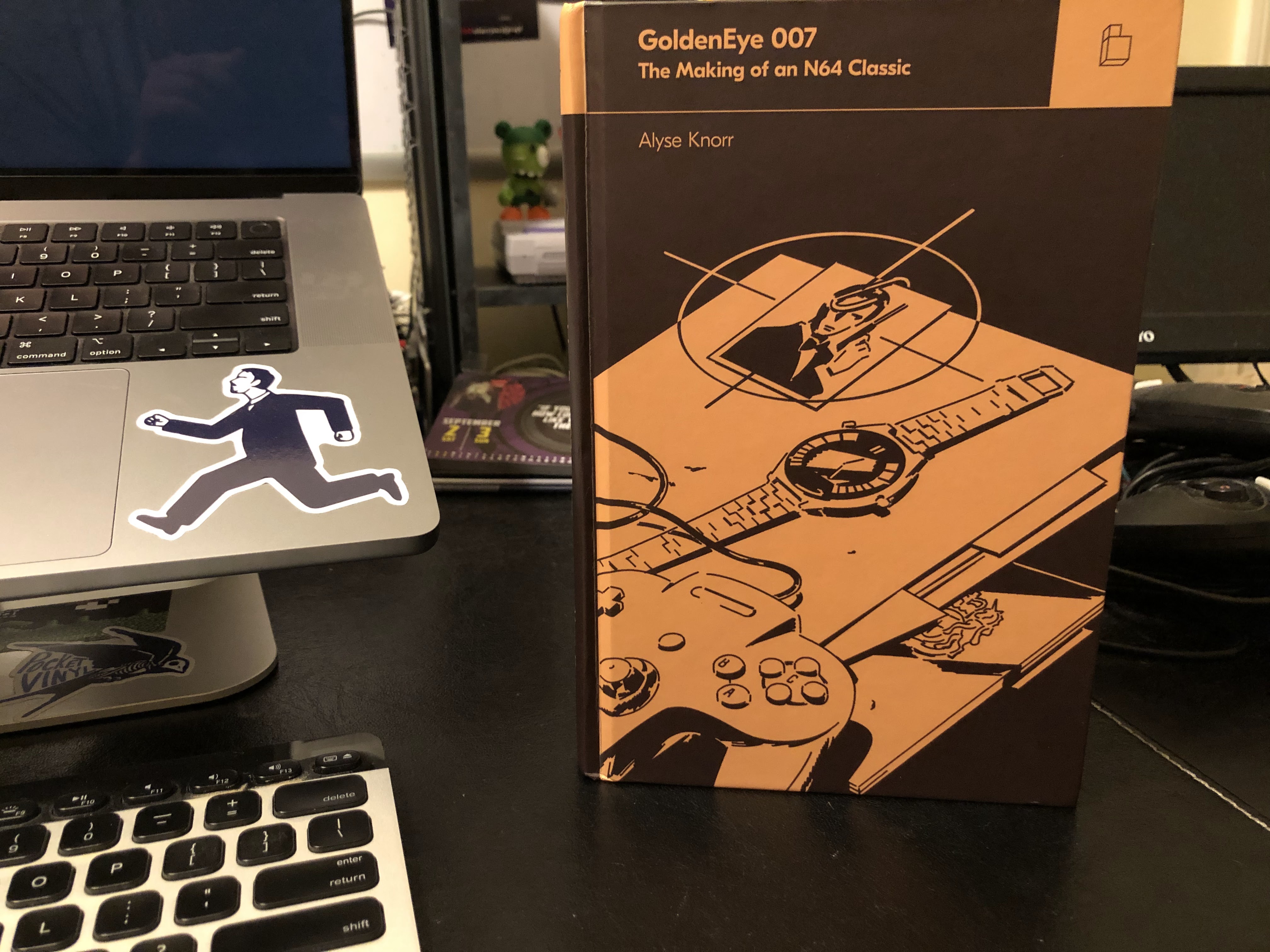
Probably my favorite cover in the entire Boss Fight Books series— Taken with an iPhone 8  
I was barely seven when Goldeneye came out on the Nintendo 64 and the only opportunity I had to play the game would not be until a few years later when I slept over at a friend’s house. We booted up the game in the late hours of the morning and, while my memory is a bit vague about what levels we played or whether his Dad rented or owned the game, we spent two hours having a blast in multiplayer. With the game now a part of the Switch Online games catalog, I was able to experience that same joy again through the single-player campaign…after I figured out the updated control scheme. Yet, it is the story about how the Goldeneye 007 game came to be which made me appreciate it even more with a recent addition to the Boss Fight Books lineup. 

Written by English professor, Alyse Knorr, Goldeneye 007: The Making of an N64 Classic is a book that provides an in-depth historical account into the how Rare developed one of the Nintendo 64’s legendary titles. There are two editions to this specific book—a regular paperback and a deluxe hardcover with design documents, pictures, and even a bonus chapter on how they developed the game’s soundtrack—and I backed the the latter during their Kickstarter campaign. No matter what edition you buy, Knorr’s in-depth account of both the game’s development and the James Bond franchise itself remains the same. Everything surrounding the Goldeneye 007 game gets through coverage—the history of Rare and Ultimate: Play the Game, what led to them and Nintendo claiming a license to Ian Fleming’s suave spy in 1995, the James Bond games which came after, etc—and the chapters dedicated to a specific aspect of development feel very much like an extended, behind-the-scenes feature for a film or television show. If you are wondering what the secret to Goldeneye’s memorable multiplayer was and how it came to be, or how they worked on the in-game models and animations, Knorr has you covered.

If you want to know how Grant Kirkhope and Graeme Norgate managed to make the iconic James Bond theme fit onto an Nintendo 64 cartridge, you will not be able to find it in the standard, paperback edition. It felt weird to me that there was a bonus chapter smack dab near the end of the book between the one on multiplayer and the other on the Nintendo 64’s struggles during Goldeneye’s development alongside how the team dealt with the violence in the game—with feedback from Nintendo and even MGM. The transition between them does not feel abrupt or awkward, but the absence of Kirkhope and Norgate’s contributions did not make any sense to me. If I instead decided on the standard edition, it would be the only setback to an otherwise well-detailed account.

The drawings, diagrams, and even reference photos do feel like a nice bonus feature with the deluxe edition. For someone like me who only had brief experiences with the game, it was cool to put faces to names, see how particular places and actors transitioned into in-game models, and how the menu’s manila folder UI developed into the file select and mission briefing screens. Players passionate about gaming history and development will be spoiled rotten with motion capture models, sketches of in-game areas, original design documents outlining what Goldeneye would be, and so much more. Both these additions and the bonus chapter combined make the deluxe hardcover feel more like the definitive edition of Knorr’s book, making it worth the US $29.95 price tag—double the price of the standard paperback at US $14.95.  

Even so, every edition of Alyse Knorr’s Goldeneye 007: The Making of an N64 Classic does the game justice in the same Boss Fight Books style—where personal narrative weaves itself with academic rigor. Compared to the other books I enjoyed—Matt Margini’s Red Dead Redemption and Gabe Durham’s Majora’s Mask—Knorr’s own experiences not only entwines itself into the stories of Goldeneye’s development, but compliments them gracefully. Her love for Goldeneye shows in both her personal experiences, and her own research and interviews with the development team. Anyone interested in the history of first-person shooters, gaming in general, or just fondly remember playing this game will find themselves with the perfect martini of a book—shaken, not stirred.   


In Sum: A love letter to a classic, late 1990s video game that goes above and beyond, but somewhat blows its cover with an extra chapter in hardcover that, while still thoroughly researched, would work better in both editions. Even so, it's a rich dossier—4 out of 5 Stars   

Boss Fight Books does sell the deluxe hardcover as an e-book for US $11.95 (at time of writing) in case you are interested in both the bonus chapter and the additional design documents, but do not want to shell out US $30 or prefer reading it in a digital format.   

05 August, 2023

An Unexpected and Welcomed Visit—Ink for August 5th & 6th, 2023

I had a cousin visit my parents' house with her three kids on Monday—she was initially in the region for a family reunion, but decided to stop by before heading back home—and we had a lot of fun. The highlight of the visit though was her son, my second cousin/nephew, finding out where the "video game room" was—it was mine, of course—and then I had the honor of introducing him to MsMadLemon and Banjo Guy Ollie since he was passionate about Minecraft. 

I linked the above video in a recent Mastodon thread—where Maddi shows off her railway system and ends up getting chased (briefly) by an Enderman—and when that scene with that shadowy creature happened, he was laughing up a storm. We checked out some of the other videos in the playlist as well including an earlier video where she explores a nearby cave, another prior video where she starts her Minecraft journey, and her tutorial on building a Hamam, before switching over to playing Street Fighter II on my Genesis/Mega Drive Mini where he ending up winning with two full bouts. 

Before that, and alongside Ollie's synth cover of the Minecraft theme, I attempted to introduce him into the Nintendo Force magazine...initially with the issue containing my Hypnospace Outlaw review. I think he was more mesmerized by the screenshots from Kris Randazzo's review of Fight Crab though—and I don't blame him! :-)

I did show him other issues of the Force—the recent one with Pikmin 4 on the cover (Issue #66), then the Eastward review from issue #56, and the one in which Metroid Dread graced the cover (Issue #55). I think he enjoyed reading them and he also talked at length about the E.M.M.I. robots in Dread since he owned those very same Metroid amiibos I mentioned previously.

That, and he was entranced by Ollie's Metroid covers—he requested the ones of Brinstar and of Kraid's hideout, while I had him guess the one for Phendrana Drifts since he had Metroid Prime Remastered on his Switch. 

All in all, it was a lot of fun and I was glad to see my cousin again after not being in touch for years. She was the person who recommended the university I ended up graduating in which, even under all the stress, is something I'm still grateful for to this day. She also ran a couple blogs in the past decade but sadly, they're both inactive and offline so I don't have any links to share. I can say from memory—and Kristin, if you're reading this, I hope I remembered correctly—that her first blog dealt was thought-provoking and dealt with sociological matters. 

Speaking of Relatives...

You can now listen to the Derek James tapes in their original, and cleaned-up, forms over on his nephew's website—Derek's nephew being Tom of Channel84. These tapes were originally showcased on CheapShow in episodes 105, 119, 140, and 278, with commentary by Paul, Eli, and Stuart Ashen (for the latter two) that helped bring these bizarre, yet lovable tales to life. I will always be fond of Derek's Bone Hoover story, not just for the sudden, comedic twist at the end but also for how he describes his journey to Cairo—I sometimes have that CheapShow episode on repeat for the commentary alone! 

I can actually imagine Derek hosting a fiction writing workshop or being famous for creative nonfiction memoirs, but I digress...

What I've been listening to recently...

I would be remiss if I did not mention MsMadLemon's latest album, Paradox. I thought about doing a more in-depth review on it, doing a track by track look similar to the one I did for Pocket Vinyl's Winter Person in 2020...and I might do so in future. What I can say right now is that this is Maddi's best work yet and the variety of synths and trackers that make up the tracks evoked a feeling similar to the soundtrack for Eastward!

There is also Lacey Johnson's latest cover album featuring her take on some of Persona 5's greatest numbers, which is also amazing of course!

But the album I thought was the most interesting was this original soundtrack from a group called Alpha Something...   

I actually owe it to Ro Panuganti for both his cover of Nee Dhaane and his playthrough of Venba for introducing me to this game that centers on Southern Indian cooking with an emphasis on family. 

Weird thing is, I haven't played it yet and as I'm writing this post, I just found out that the game is also on the Switch. This is what happens when I more or less watch YouTube solely on the iPad these days so the video description stealthily hides itself behind a tappable word. I did rectify this and downloaded the game from the eShop and I think it will be a good way to partly spend my weekend.

Much like Turrican, its a game where a cover and a soundtrack inspired me to buy the game, so here's Ro Panuganti's take on Nee Dhaane with his first try at Southern Indian cooking with dosas and chutneys...

...and that's all from me for now! I hope you all have a wonderful weekend!

28 July, 2023

An Updated Review Timeline and a Brief Amiibo Addiction—Ink for July 28th, 2023

Urban planning makes the best of geographic oddities. —Captured on Switch (Handheld Mode) 

I'm changing the timeline again with regards to rest of summer's reviews partly because of the usual culprit—although that's game's mostly wrapped up (for now)—but also because of one addition to the roster.   

I'm still working on reading through Goldeneye 007: The Making of an N64 Classic by Alyse Knorr and should still be on target to have a review written and published here next month. Islets will also be a review for late-August (or early September), but I'm also tacking on another game which evokes the same laid-back, summer feel. It also revolves around islands with a related namesake, Islanders: Console Edition, and was recommended to me by Ivenne, a friend of the blog and the creator behind the [Un]Official CheapShow Magazine! 

I'm aiming for somewhere between 750-1250 words for the combination review and there will be scores. (Spoilers: They're both fun!)   

As for the last item in the queue, I'm aiming to read and review The Good Luck Girls of Shipwreck Lane sometime in September.    

So that's the admin done, I thought I'd talk about what the Tears of the Kingdom shenanigans hath wrought... 

Top: A Solid Cast of Links—from the 8-Bit beginnings (rightmost) to when he composed music at sea (leftmost)—with a spider-esque robot lurking nearby.
Bottom: A Better look at the Windwaker Link & Zelda alongside the princess from her Skyward Sword days. —Both taken with an iPhone 8    

One of the things I didn't expect to do while playing this game was to break out the wallet for additional Amiibo figurines. These Amiibos have a Near-Field Communication (NFC) chip located at the base designed to interact with the NFC chip on a Joy-Con or an official Switch Pro controller to allow players to further enjoy additional features with particular games. In both Breath of the Wild and Tears of the Kingdom, they provide a cache of resources alongside a treasure chest containing either a normal weapon or shield, a gemstone, or an exclusive piece of armor related to the Amiibo in question.

Thing is, even if they said there was a restock on Zelda Amiibos upon the game's release, I never thought to take advantage of it. Then again, I wasn't really in the market for them beforehand—I had the 8-Bit Link one already alongside an 8-Bit Mario figure, the Metroid Dread dual-pack, and Mr. Game & Watch—since most of the games I played either didn't use them or had Amiibo-only features that I felt like I didn't need. The ones I already had were close to the regular retail price that the Nintendo Life article lists for the reissued Links (around US $14.99) with the exception of the Metroid dual-pack that was closer to US $30.

But when I found the Link from Majora's Mask on Amazon for around US $38 when it scalpers usually sell it for way over US $100, I can't say no to a figurine from what is my favorite Zelda game of all time! 

Here's the thing, you don't need these Amiibos if you're looking for exclusive armor and weapons in Tears of the Kingdom. You can find chests in caves and the Depths where you can net them without having to shell out money to a scalper or braving a games store as someone over thirty looking for what could be called a kid's toy. Without spoiling anything, the trek is worth it alone no matter how you end up finding them!

...and that concludes my Tears of the Kingdom ramble. Hope you all have a wonderful weekend!    

28 June, 2023

The Shenanigans Won Out in the End...

Much like Return to Monkey Island, the uploaded screenshots won't do Islets any justice—Captured on Switch (Handheld Mode)  

Tears of the Kingdom has been my go-to game for the past couple months and, even if I did manage to do a playthrough of Islets in-between sessions, I don't think I could give a proper review to the indie metroidvania. I started writing a draft yesterday with an intro that (ideally) would transition from praising an open-world game for not having an overwhelming narrative to how Islets evokes a similar feeling for a metroidvania game, but it felt way too ambitious. It probably wouldn't make much sense either. 

I also made a post on Mastodon a couple weeks ago saying that I was on track for both reviews and, I admit, I got ahead of myself. 

In short, I'm pushing back almost everything...

  • I'll have a review of Islets up by late July, meaning that I can do a full playthrough on Normal and a more in-depth one on Hard
  • Red Team Blues will be a review for earlier in the month while moving Alyse Knorr's Goldeneye 007: The Making of an N64 Classic back into August. (Although it could also be a late July review as well...)
  • I'm still aiming for August to finish reading and review The Good Luck Girls of Shipwreck Lane for the blog alongside Knorr's book

Hope you all are having a great summer so far!  

23 May, 2023

A Glimpse Into What Summer Will Look Like This Year...

A in-depth look into the history of James Bond's Nintendo 64 debut, a cyberpunk thriller, and a Metroidvania that takes place in the sky— Taken with an iPhone 8

Sunday won again, but that was more or less me getting distracted by Tears of the Kingdom, which has been a beautiful experience that can sometimes be a little overwhelming. I'm not going to spoil anything here, but I did write a small thread on Mastodon with my initial thoughts on the game. The individual posts are all behind sensitive content filters, but the first one is spoiler-free and provides a window into my foray back into Hyrule. That, and it also highlights the way I played through Breath of the Wild along with how I approach open-world games.

I'll end up writing a few more posts on the game there as I play it, but for the next game review, we'll be going to a different set of sky islands!

Earlier into the year, I decided to sign up for the Super Rare Club, which is a service from Super Rare Games that more or less allows you to pre-order games earlier than the general public alongside a few other perks like exclusive merch. They are a company that specializes in physical games—like Strictly Limited and Limited Run—but solely focus on indie developers who might otherwise be overlooked. I've been a fan since I stumbled upon Project Warlock, which was Jakub Cislo's take on Doom that added role-playing game elements into the mix (plus magic spells). Some of my favorite Switch games are straight from Super Rare Games's physical releases—The Lion's Song and The Flower Collectors from Mi'Pu'Mi Games, Horace, Deponia (eventually in its entirety), and Dicey Dungeons to name a few. 

So when they announced Islets alongside the featured trailer, I thought that it would be right up my alley between the genre and an art style that fits itself gracefully between Hollow Knight and Monster Boy and the Cursed Kingdom. 

My plan is to do a run on easy mode first to get the full narrative experience while getting a feel for the exploration and gameplay mechanics. Then, I'll do a playthrough on normal to see how difficult the bosses and combat become to provide a (more) proper review. 

I'm aiming for late-June to write and publish the review—possibly July if I'm sidetracked by more Tears of the Kingdom shenanigans. (Although, I feel like I've made enough progress to take a little break.)  

As for the books...

There was a tie in the results between Cory Doctorow's Red Team Blues and Alyse Knorr's Goldeneye 007: The Making of an N64 Classic. I though that, instead of doing a tiebreaker poll, I would read and review both books starting with Red Team Blues and then doing Goldeneye 007 with the review for the former being slated for June. I'm aiming for July for the latter...

...and I'll also be doing a review of The Good Luck Girls of Shipwreck Lane in August—or July if I finish reading it before then. 

Thank you to everyone who voted in the polls! I think this will be an excellent summer for blogging! 

20 April, 2023

Axiom Verge 1 & 2: Nostalgic Patterns Diverted and Conceived Anew

What Led Me to Axiom Verge, Plus the Physical Edition's Second Cover. The First One Being 8-Bit Trace and Indra I Posted to Social Media. —Taken with an iPhone 8

I grew up on science fiction—more or less thanks to my Dad who loved the Dune books to death, so falling in love with the Metroid in Medroidvanias seemed like a no-brainer. That was what happened with Metroid Prime in 2002—a game which twelve-year old me thought would be more like a zombie shooter than an in-depth exhibition on an almost uncharted planet. One kiosk session later, I was proven wrong in the best way possible and, with my Dad already being interested in the game, purchased it about a month later. Samus’s adventure on Tallon IV would bring me down a sort-of Metroidvania rabbit hole from Fusion to Zero Mission, eventually leading me to the NES and Super Nintendo titles respectively by means of the Wii’s Virtual Console. 

Fast-forward a decade and I dive back into that same niche, but with a wider variety of games—Hollow Knight, La Mulana, Horace (for a few chapters), A Robot Named Fight, and more recently Islets—but the one that I shelled out money for first was Axiom Verge. I was no stranger to that game since, much like with Shin Megami III: Nocturne, I discovered it through a stream from LoadingReadyRun and made it another game on the “to play someday” list in my head. It was to the point where I actually bought the soundtrack on iTunes long before I would finally play it, falling in love with the rough synths and the warbling theremins. The moment I downloaded the game proper to my Switch was when I could finally cross that game off the list…and cross it off once again.

One of my better action screenshots from the first game, in which Trace employs the address disruptor to scramble a mantis-like creature —Captured on Switch (Docked Mode)

Developed by Thomas Happ, Axiom Verge is a metroidvania that looks like 8-bit Metroid and somewhat acts like it too once Trace Eschenbrenner wakes up after an experiment goes awry. As he explores the planet Sudra, picking up a few new weapons for his Axiom Disruptor, the game starts to stand on its own in a similar way to how Prime did for twelve-year old me. The Disruptor upgrades are only the beginning as Trace discovers ways in which the world can be corrupted like a game cartridge to help him traverse chasms or even outwit fast enemies. There is also a lab coat that allows him to phase through walls and a spider drone that acts as a tribute to Metroid’s Morph Ball while emphasizing its own unique spin by mining through bits of rock.

Exploring Sudra does feel slightly linear, in which your lack of upgrades drives you to almost going in one direction. Yet, the exploration still feels natural. You are able to figure out where you can go and what you need to go elsewhere without a supercomputer’s authorization—unlike Adam in Metroid Fusion. Pickups, ranging from your health and power nodes to lore, do take some additional exploration to find and the payoff is usually worth the trek. 

The game’s story is deceptively larger than it initially leads you to believe as Trace navigates Sudra and assists the Rusalki supercomputers. Without spoiling much, the pixelated mess scattered across the lower caverns and planet’s surface is part of a much large phenomenon called “the Breach” and some guy named Athetos allegedly wants Trace dead. Trace, of course, wants to find his way back home to Earth, but as the story progresses, everything seems to blend together. This is far from a criticism of the story and the twists show Happ’s strength in character-driven storytelling alongside solid world-building. At the same time, those revelations may make things a little confusing on a first playthrough, even if the lore helps in patching some events together.

One of the many challenges with the sequel's emphasis on melee combat. Like in fencing, a smaller target usually has the advantage —Captured on Switch (Handheld Mode)

What Happ made here was a package for those crave Metroidvania exploration with a story that is surprisingly deep for its length. Six years later, he would do it again with Axiom Verge 2 by keeping that sense of wonder intact with changes in gameplay and a story that works in tandem to subvert the player’s expectations.

This new chapter stars Indra Chaudhari, CEO of Globe 3, who decides to investigate a research station in Jones Station, Antartica after receiving a message on a microcomputer she received from her acquisition of Hammond Corp. This communique orders her to go there for her daughter’s sake, but what she finds at Jones Station is not just a desolate facility, but a portal to another universe. 

From stepping out of the freight elevator, Indra’s life begins to change completely and that is where those changes to gameplay step fully into the limelight. Gone is the Swiss-army-knife-for-a-gun that was the Axiom Disruptor in place of melee combat by means of axes, daggers, swords, and boomerangs. There is even an augmentation that allows you to hack machines and enemies in order to gain a tactical advantage, open doors, or just navigate up a mountain. These augmentations, or Arms, allow Indra to fully transverse this new alternate universe called Kiengir, and let Axiom Verge 2 shine as its own game. 

Using some of these Arms, to hack or cause shockwaves, cost nano-machines (nano points) and the new in-game pickups help make up for these new challenges. There are still health nodes from the first game, but now there are flasks you can break to gain skill points for stat building. Luckily, the stat trees are not overwhelming and you can easily break enough flasks in order to survive by the means that best suit your play-style.

A mish-mash of pixel-art, chiptunes, and callbacks. The Breach that binds the games together —Captured on Switch (Handheld Mode) 

With all these gameplay alterations, one would think that Axiom Verge 2 would be almost indistinguishable from its predecessor as a difficult, ambitious flop. That is far from the case. The music score makes this evident from the second area onward, where the acoustics and vocals from Mayssa Karaa, make Kiengir feel like a comfortable hike on the trail or teatime on a quiet day in. The unashamedly stereotypical, science fiction ambience created by Axiom Verge 1’s soundtrack has not been fully discarded either, but instead gracefully blends in with the sequel’s calming atmosphere…at least, when you are outside the Breach.

That same pixelated hot mess that caused chaos on Sudra can now be traversed in brief by Indra as a spider drone once she meets the respective Arm. What is within is not a hotbed for a digitized apocalypse, but a sort-of pocket universe with a chiptune soundtrack full of amplitude, which manages to work almost  in parallel with the rest of Kiengir. It is an added dimension which adds depth to an already well-rounded world and mastering them both is key to fully figuring out the mysteries behind Kiengir, Hammond Corp, and what happened to Indra’s daughter, Samara.

Without spoiling too much, the drone itself plays a huge role in the story—both the Arm that allows it to manifest and with Indra herself. Players familiar with the first Axiom Verge will find themselves subverted by their expectations more so, considering what the drone could do prior. Is it just the melee combat? That is a question best answered by playing the game itself.

With all the major changes, the game maintains a reasonable length in which I could finish it between six to eight hours—more so if I wanted to collect everything. It never feels like it overstays its welcome nor does it abruptly end and leave you wanting more. Every part of the game and the storyline fulfills its role without delay, which can also be said of the first Axiom Verge. 

It's hard to tell, but sometimes, the most important items in a Randomizer run can easily be overlooked —Captured on Switch (Handheld Mode)

Which reminds me, that update in early 2021 which included the Randomizer mode is phenomenal! If Axiom Verge 2’s story made me further appreciate the narrative from the first game, this new gameplay experience gives this debut title an extra dollop of spice. What it does is in its namesake—move around all of the items, make a path based on your inventory, and defeat the final boss. If you want to up the challenge, there are two more advanced difficulties that add in more of the lore items and even move vital items to almost unreachable places. Hardcore players may get more enjoyment out of those options, but the basic level is perfect for another journey through Sudra. 

Technically a secret, but one that is best found out while playing. Not a major one, but its worth the trek. —Captured on Switch (Docked Mode) 

No matter where you start your journey, Axiom Verge 1 & 2 are adventures with nostalgic roots that branch out into their own interplanetary (and inter-universal) niches. Thomas Happ’s passion for his craft shows in every detail, from the story to the exploration elements and combat. Nothing on Sudra or Kiengir gets overlooked, even when corrupted by the Breach. 

Whether the Breach clears up or not, the Axiom Verge series is one case where the creation of a new universe was both a good and wise move.   


As mentioned previously, I'm not giving these two games a numerical rating—they would hover at an almost perfect 10. However, if you asked me which game I prefer excluding the Randomizer update, I would go with Axiom Verge 2 partly for the story, but also because of how ambitious the game was overall. 

That and the soundtrack!

This has been an almost constant earworm since I first listened to it and, for some reason, it reminds me of Amiga MODs blended with some synthwave. Admittedly, I'll sometimes have this on repeat as well...

13 April, 2023

There Would've Been a Top 10 Games List for 2021, but I Let it Woosh By...

My Game of the Year for 2021, plus an example of one of my better action screenshots. —Captured on Switch (Handheld Mode)

Note: There's early spoilers for Eastward in this post. This is a game I recommend playing blind if you're into a top-down, Zelda-like experience for the story alone. 

So last year, I had this idea of doing a personal top ten for my favorite new Switch games for 2021. Some of my own rules included that I couldn't places games on there that were already released on different platforms, meaning that Shin Megami Tensei III: Nocturne and Disco Elysium: The Final Cut would be honorable mentions. 

Here's what the top five would have been...
  1. Eastward
  2. Metroid Dread
  3. Shin Megami Tensei V
  4. Axiom Verge 2
  5. Cotton Reboot!  
There's a nice combination of well-known franchises—one unexpected comeback and another with four years in the making—a full-on remake of a classic title, a sequel to an well-received indie title, and another indie game that blew me away.

Developed by the team at PixPil, Eastward was one of the options in my first poll to decide which game I'd review for the blog. It was a game that started gently, in which Potcrock Isle's resident miner, John, and his adopted daughter, Sam, lived an almost quiet life in an underground enclave. Fellow residents feared what wonders existed on the surface with an air of conspiracy, and would openly shun those associated with anyone who dared to set foot on the forbidden soil (whether by choice or not). Even worse, in John and Sam's case, wandering around an abandoned grocery store which coincidentally leads there is a one-way ticket on Charon.

Yes, Charon, but also not exactly. John and Sam are merely exiled into the rest of the world which has managed to make a niche for itself with boats substituting as dwellings and an entire city sitting on the side of a dam. The game's art direction does the game's world justice in a way that my brief descriptions never could—reminding me of both the old Mario & Luigi role-playing games alongside the Secret of Mana—and Joel Corelitz's soundtrack adds just enough spice (and 80's-sounding synths) to make that eastbound journey worthwhile.       

For me, Eastward, was a game that felt very character driven with John and Sam at the helm. Even the world-building integrated itself around the conceit. Having the entire setting almost play second-fiddle works in this game's favor, and I don't think that I can say that of many games. Not to my knowledge anyway. 

Part-Roguelike, Part-RPG, and slightly more significant than this screenshot leads on —Captured on Switch (Handheld Mode)  

What made this even better was one motif: Earthborn. A game that you could play in-between tasks. A in-game television show, which seemed to be the only thing on air anywhere—even on Potcrock Isle. A cultural phenomenon that is highly revered by the characters who grace Eastward, both major and minor.

It gave the game an extra layer of literary depth and without saying too much, they make it work spectacularly!

That, and it helped make Eastward into an ambitious package that managed to make everything work in an almost-perfect state of synchronicity.

Too early of a screenshot to be used in the review proper, but it works as a transition...sort of. —Captured on Switch (Handheld Mode) 

Enough rambling about Eastward though...

The idea ended up being forgotten, but in hindsight, I'm glad that it actually didn't come to fruition. Replaying through both Axiom Verge 2 and Shin Megami Tensei V (a little after I reviewed it) made me think that their placement on that list was wrong.

I feel like it could be explained better like this: I ranked Metroid Dread below Eastward because, while Dread was an action-packed tour-de-force, it was mostly familiar territory. In this case it's far from a bad thing because of the fact that the game felt exhilarating. That feeling helped in preserving the nostalgia I had for the series while giving it a newfound respect for the work put in by the developers.  

It of course helps that Dread had a solid story to reinforce the gameplay elements, but the same cannot be said of Shin Megami Tensei V. I noted that the game's allegorical story was very weak in the review, since it seemed to favor one side over the other. The battles, and the pseudo open-world gameplay held the game together, but on a new game where you can keep all of your old demons, the whole thing does not hold up the second time around. 

Axiom Verge 2 does, and I'll let the eventual review explain itself and why I now want to place it in my top three for 2021. 

Until then, I have two words: third playthrough. 

19 March, 2023

The Little Book of Sound Chips Volume 2: An Audio Powerhouse in Book Form

A second installment that fully embraces the chiptune sounds from across the Atlantic (and beyond)—Taken with an iPhone 8

Note: While the book's presentation is unique, I'm not keen on sharing photos of individual pages. Instead, I embedded some YouTube videos which highlight tracks and demos featured in the book itself.   

As gaming becomes recognized as mature medium for both its artistic merits and value in entertainment, scholars and enthusiasts are doing their best to document many early milestones. There are companies like Digital Eclipse who come out with fantastic anthologies, allowing the player to experience older games almost seamlessly via emulator while letting them comb through old manuals, box art, and even interviews with the developers themselves. Non-profit organizations like the Video Game History Foundation alongside hobbyist initiatives like the Retro Collective in Stroud, United Kingdom do similar work—hosting interviews on their respective podcasts, restoring microcomputers and scanning video game magazines for visiting patrons and scholars alike, and backing up ROM files as a means of preserving gaming history among other initiatives. 

When it comes to books, the Retro Collective’s Neil Thomas (RMC-The Cave on YouTube) has transcribed his podcast interviews into books form while Boss Fight Books works on weaving literary analysis and historical anecdotes with personal narrative in their ongoing book series. French book publisher Geeks-Line and Jeremey Parish catalog gaming consoles and their associated back catalog, condensing the work of the above groups into another digestible form. 

The trouble with these books is the fact that…well, they are read-only for a medium lives and breaths on player inputs. That and, if you are like me, then you may be wondering how you can at least experience the music from these games. This is where Chris Abbott and Andrew Laggan come in with their Little Book of Sound Chips series. With these books, technical documentation meets a museum formed from pages—whether you are flipping through the print version or surfing through the digital version dotted with hyperlinks. Published by the minds over at FusionRetroBooks, these books are gaming at not just a glance, but a radio broadcast clear of static and full of chiptune goodness. What makes this even better is these books are easily affordable—Volume 1 comes to £9.99 or US$12.17 while the second installment costs £14.99 or US$18.26 (currently on sale for £7.50 or US$9.13 at time of writing)—so you do not need to shell out a good chunk of your paycheck to experience what makes video games memorable.        

I backed both the first and second volume when FutureRetroBooks hosted their campaigns—and it was the second book that incentivized me to fully support this line of literature. My earliest moments in video games include the time when I accidentally pressed the eject button while my Dad played through Yoshi’s Island alongside all the moments I spent at a family-friend’s house playing Banjo-Kazooie, Mario Kart, and Mario Party, which in theory, would make me more inclined towards the third or fourth installments. When you discover the SID chip through a Canadian comedy troupe turned video production house and Paula through the many Amiga enthusiasts on YouTube, this makes it a different story.

The Little Book of Sound Chips: Volume 2 was the book I had most anticipation for where I could finally figure out what makes SID, Paula, Ricoh (NES/Famicom), and Yamaha (in the form of the YM2151) tick while also highlighting other arcade sound chips alongside more obscure ones. Some of the technical descriptions were slightly difficult to understand, but those who are well-versed with music and computer processing will appreciate the attention to detail. The brief glossary at the beginning of the book made much of these passages comprehensible without making me feel lost or lacking in knowledge—even if some of the jargon still seemed dense at some points.

This focus on the technical aspect of these chips is far from a setback in what is a great foray into video game history. Abbott and Laggan clearly want to make a book on music history in gaming for both computer-savvy technicians and those who fondly remember cruising down the beach in Outrun with “Magical Sound Shower” or “Passing Breeze”. For the latter crowd, the highlight comes in the form of myriad pages after the technical introductions and background history. Each of these sheets consists of the game’s title followed by a small (sometimes cheeky) description, a picture of gameplay, and a QR code. If you have a smartphone or tablet at the ready, these codes are a gateway to a YouTube video where you can hear the sound chip in action—and more importantly the soundtrack of said game. Sometimes, there is some gameplay included, especially with some of the Commodore 64 and Amiga titles, making this book into the afermentioned museum that I personally did not expect while reading through it.

Thing is, soundtracks are only a portion of what makes this book a solid entry about gaming history. Going back to the technical descriptions, you sometimes get a historical overview of the composers who took advantage of particular sound chips like with Rob Hubbard, Ben Daglish, Martin Galway, and many, many others who took advantage of both the SID and Paula chips in order to create soundtracks that made even the badly reviewed games worth playing. Missing these because the technical rundowns might be slightly difficult to comprehend takes a chunk out of what (and more importantly who) makes these soundtracks into something groovy and memorable. 

Same can be said for the brief introduction into the Amiga demoscene and the chiptune music scene that the Nintendo Entertainment System’s (Famicom’s) Ricoh 2A03 inspired. The way these composers use said sound chips among many others to create unique numbers is one of the driving forces behind electronic music—and in some cases dance music—making this book into a historical powerhouse. Without Ricoh, you would not have the likes Jimmy Hinson (Big Giant Circles) or Anamanaguchi, nor would you have soundtracks from composers like Shovel Knight’s Jake Kaufman or Cecconoid's H0ffman. With the QR code sections usually ending up with homebrew games of demo tracks, the respective music scenes only add to an already excellent showcase with spice and amplitude.

The biggest issue this book has come down to the possibility of link rot because these videos are all hosted on YouTube. It is unclear if, or when, these videos may be taken down because of a DMCA copyright claim, which is not the fault of the writers. That is a larger problem for both gaming historians and composers (professional, indie, and enthusiasts alike) to solve over time alongside larger parties—both in politics and tech. Of course, you can always search for the soundtracks and demos on YouTube by keyword, but the varying results might give you the wrong track (or the right track, but the wrong sound chip). For now, the QR codes work continuing to make this book sing with every audio chipset.

I do have one piece of advice though: If you want to scan the QR codes, you might want to make use of your tablet instead of your smartphone. Since it does not open with the YouTube app, but in a separate webpage, the play button is small. If you pause it, you might end up hitting one of the suggested videos unintentionally.

Otherwise, The Little Book of Sound Chips: Volume 2 is a tome of happy listening that both acts as a gateway to nostalgia and a portal to gaming history. Whether you are a retro gaming enthusiast, music composer, or even just love music for the sake of it, this book will sit proudly either on your shelf or your coffee table.   

The songs and documentation speak for themselves. No additional tuning required. 5 out of 5 Stars.

08 October, 2022

Return to Monkey Island: A Rich Glass of Grog, and an Aged Fine Wine (Switch)

 A Determined Pirate Gets Sage Advice—Captured on Switch (Handheld Mode) 

I’m a bit ashamed that, with my growing love of point-and-click adventure games, the Monkey Island series was only a cluster of islands on the acoustic archipelago. Being conceived during the dawn of the nineties meant that I would miss the first two titles developed by Ron Gilbert during his time at Lucasfilm Games—while it was known as LucasArts. My earliest experiences with the genre were the edutainment titles by Humongous Entertainment that were a fun romp as a kid, but not so much now—a couple decades older and somewhat wiser. I was left wanting so much more and most of the Sierra games—that I am aware of—only run on Windows, at least according to GOG.      

So I sought out other titles like the Sierra-inspired Guard Duty, the comedic sci-fi quadrilogy Deponia, and  a callback to Maniac Mansion titled Thimbleweed Park. The last game, developed and published by Terrible Toybox, had Ron Gilbert on the team—early Monkey Island’s very same. I admit that I have yet to fully finish a playthrough—I’m a little past the halfway point—but the writing is something else in the best way possible. So when I read about, then watched the announcement for Return to Monkey Island, I decided it was finally time to dive in…

…and I regret nothing.

Passing on the Legacy In-Game, the Threepwood Way—Captured on Switch (Handheld Mode)  

Return to Monkey Island starts out with a fun little prologue of a tutorial staring Guybrush Threepwood’s son, Boybrush, and his friend, Chuckie, playing around in an amusement park. Even if you are familiar with the basics of any point-and-click adventure, Ron Gilbert and the team making this teaching experience an enjoyable one with a fully-voiced cast and little sprinkles of humor that lead into the grand adventure itself:  A journey in which Guybrush Threepwood (voiced by Dominic Armato) plans on traveling to Monkey Island to uncover the Secret and ultimately one-up his ethereal adversary, LeChuck (voiced by Jess Harnell).

It is impossible not to fall in love with Threepwood’s antics as he unintentionally causes chaos on his journey. Every item he needs requires him to walk straight into events of roughish mischief with an equally lovable supporting cast that seems to roll with his punches...mostly. They even make the fourth-wall a part of the world—or, they aware of the fact that they are in a video game and just roll with it like a normal workday. Guybrush Threepwood is truly a master of metatheatre. More importantly, so are Ron Gilbert and Dave Grossman who not only designed this game, but wrote the story in which everything just works together. The music and artwork only add to the charm, bringing the tropic locales to life alongside undead deckhands.  

Even if, like me, you are mostly unfamiliar with the Monkey Island games, Return is a perfect entry point into the series. There is a scrapbook on the menu screen that provides a voiced recap of Threepwood’s previous adventures if his past voyages pique your curiosity. The story itself, however, does not require past knowledge of previous games to understand Threepwood’s world…unless you want to try your hand at the trivia cards.  

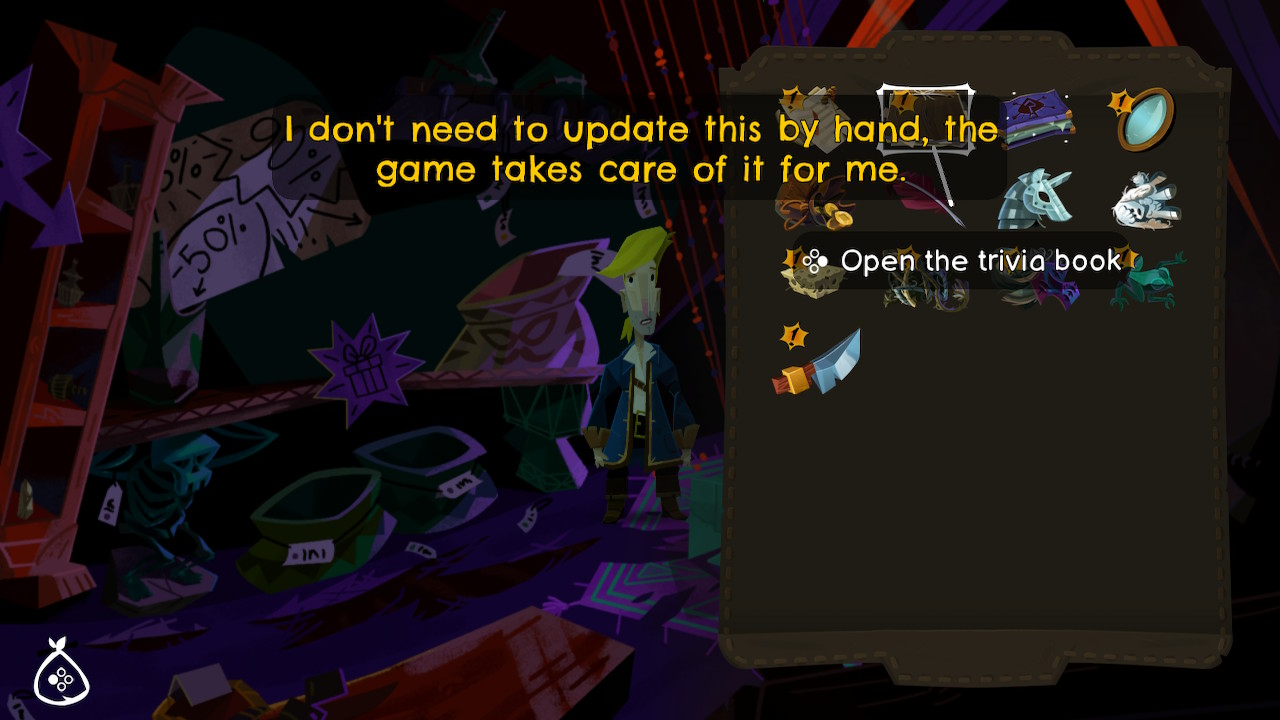
Just one golden nugget...out of many. (Pst! He's Describing the Quill!)—Captured on Switch (Docked Mode) 

Question: How does the gameplay far on this Return to Monkey Island? Answer: Smoothly. 

You can use either the touchscreen or the controller to guide Guybrush Threepwood on his journey back to the namesake island with little trouble. It does feel slightly more awkward with the controller—as in, I sometimes found myself missing important items in a room—but the game’s use of the top-shoulder buttons makes this a non-issue, allowing you to cycle through every highlighted object until you find the one you need. 

Outside my minor fumble, everything else about the gameplay and the interface is truly a matter of pick-up-and-play. Or rather, in this case: Pick up, discover, and explore. There is also a hint book you obtain early in the game which, when a puzzle completely stumps you, provides a couple of lines to prod you in the right direction. 

Speaking of puzzles, the difficulty modes do a good job of providing the player with the choice between smooth-sailing for the story (casual) and a full-on head-scratcher (hard). If you went from a casual playthrough to the more difficult one like I did, your interpretation of “full-on head-scratcher” may vary since the more challenging puzzles mostly just stick some extra bits and steps on the older ones.    

There is also a neat little option that acts as a sort of “director’s cut” to the in-game dialog—ideally extending the writing. I say ideally since I also started my hard mode playthrough with the option turned on so its a little unclear how it works. That bit of mess is on me though.

No, Not the Artwork...I personally dig it—Captured on Switch (Docked Mode)

The love Ron Gilbert and his team have for the Monkey Island series emanates in every detail of this unexpected installment. Return to Monkey Island is not just catering to long-time fans of the series, but to newcomers like myself who want to join Threepwood’s journey to possible riches. Unless you are a trivia buff or have a heap of Monkey Island nostalgia, this game perfectly stands alone with every character being memorable in both a loving and comedic way. What was simple in point-and-click gameplay is made simpler in controls, but the puzzle difficulty is left up to you. Spoiling this game further would be a disservice as it is an experience full of heart, japes, and barrels stuffed with grog and limes. In other words, I would set sail and make the pilgrimage to Monkey Island if I were you. 

In Sum: The Secret is a glass of grog, rich in flavor and easy to pick up. It is a tale that does not require multiple nights at the bar listening to stories and sea shanties past. If it was a wine, it aged gracefully and will never pixelate: 9.5 out of 10 

Additional Notes: As I'm writing this, there's an ongoing Kickstarter campaign for a book detailing the history of the Monkey Island games from French book publisher, Third Editions. Simply titled The Mysteries of Monkey Island, the book dives deep into the worlds of both Guybrush Threepwood and the team who created the games themselves. It goes without saying that it's not sponsored, but when I went to change my pledge for another campaign (the one for Fusion Retro Books's Annuals), this one popped up in my suggestions. After my experience on Monkey Island, I couldn't say no...

If you're interested in backing it, the campaign ends on October 17th at 11am (EDT).

30 May, 2022

Chrono Cross: The Radical Dreamers Edition—Lost at Sea, Grounded in Time

A Polygonal Finisher—or "Classic" mode in its full glory. (Captured in Handheld Mode)

Nintendo Force ran a Player’s Poll survey in their forty-eighth issue asking readers about their favorite third-party titles and companies. I decided to write in—having almost nine months time with the Switch—saying that the company I loved the most at that moment was Square Enix for putting their back catalog of late 90’s (and early 2000s) Final Fantasy titles onto the Switch. When I first got the Switch and jumped onto the eShop, one of the first titles I bought from that set was Final Fantasy VIII after recalling Kim Justice’s in-depth review and narrative analysis of the game. Then a couple weeks later, I decided that I also wanted to see what all the fuss was about with Final Fantasy VII and Louis Rossmann’s YouTube AMAs (ask me anything) are to blame for my purchase of Final Fantasy IX when it went on sale. I have yet to finish any one of these, but to be able to experience some of the best Japanese role-playing games that I could only experience previously via YouTube walkthroughs is an incredible thing.

That Nintendo Direct announcement of Chrono Cross: The Radical Dreamers in February took me by surprise. My only exposure to its prequel, Chrono Trigger, was with the port on the Nintendo DS shortly before I graduated high school in 2009. I remember, more than anything else, turning it on just to listen to the soundtrack, but the game itself pulled no punches. It was a time travel story, but it managed to keep things simple with a memorable cast of characters, a tired and true battle system, and a small world map which made every place matter—even the optional ones. 

Chrono Cross ideally would follow a good opening act with a grand show, right?

Minimalism is Radical Dreamers's greatest strength. (Captured in Handheld Mode)

Before we answer that question, let’s tackle the other game in the Radical Dreamers Edition—the collection’s tagline namesake. Radical Dreamers: Le TrĆ©sor Interdit—which translates from French as “the Forbidden Treasure”—was an obscure visual novel  that required a Super Famicom and Satellaview peripheral so you could download it via a series of well…satellites—occupying a strange space between Sega’s Mega Modem and high-speed broadband. Visual novel may be a bit of an overstatement here as most of the screens look more like a text adventure game or MS-DOS, but the blackness in and of itself makes up for it.

Radical Dreamers puts you in the shoes of a Serge, a musician who finds himself teaming up with a thief named Kid and her partner, Magil, in order to infiltrate Viper Manor and nick a jewel called the “Frozen Flame”. The game is not shy in letting you know that you are back in the world of Chrono Trigger as many players who played that game, or are familiar with the story, will already make a connection in the opening scene where the trio mucks around the manor’s perimeter. Upon entering the manor, the screen goes black, you go down one end of a corridor, a somber track plays while Serge narrates their journey, and a Griffin screams at you with its claws ready to tear you apart.

That last part is one in a possible series of random encounters you will experience in sneaking around the mansion. Sometimes, it’s a skeleton who is usually easy to deal with, a goblin that takes pride in its combat training, a ghost who whooshes in with the wind…or its the griffin. The creature’s 16-bit shrill, which comes out of nowhere, always made me jump, but many of these encounters do require you to be alert and ready to choose your next move. If you do nothing, the monster might come out on top and force you to go through the entire game again. If you know the right path in the manor, it is only a minor inconvenience, but your first few heist attempts may be slightly frustrating.

Thing is, these encounters add to the already foreboding atmosphere of Viper Manor. There’s barely any music in the game and the track which plays while you sneak around makes the place more like something out of a horror movie. Most of the rooms, which do have proper backdrops, are dimly lit. If the griffin was not scary enough, the development team made excellent use of the Super Famicom’s sound chip to make the manor seem haunted for its strange emptiness and odd architecture.

For a game you could easily complete in an hour’s sitting, Radical Dreamers does a bang up job of making the trek worth it. This was easily my highlight of the collection, both as someone who played Chrono Trigger and a fan of little gaming oddities, and I might go through this again one day to see the multiple endings for myself.

In Which a Fisherman Deals a Possibly Fatal Blow to a DRAGOON (Captured in Handheld Mode)

Chrono Cross, however, is a different matter which started out as a promising trip in one of Nostalgia’s newly constructed side streets. You start out as Serge, but instead of treading around a well-guarded mansion in the cover of night, you find yourself ascending an ancient, ornate building. Kid is still with you and your mission this time is just to take down a character called Lynx—who was also Viper Mansion’s owner in Radical Dreamers—with some other person who is one out of a myriad number of party members you can recruit. Upon entering the chamber that sits way above the building itself, Serge witnesses himself, blood dripping from his dagger with a sly grin on his face as the screen flashes to Kid lying on the ground, dead.  It gets stranger from there as this whole sequence was merely a dream and the Serge of Chrono Cross has no idea who Kid is.

The game’s opening moments do a genuinely decent job at introducing the story and core gameplay mechanics, but the battle system feels very unwieldy. Instead of the Active Time Battle system used in Chrono Trigger—where using Techs was as easy as casting a simple spell—Chrono Cross makes an attempt at making its fights stand out from similar games. Attacks take a certain amount of stamina, meaning that you can put a good amount of oomph into a strong strike, or chain a flurry of weaker attacks to keep your party from completely wearing down. These attacks also help to fill up an “element” grid for each character so they can cast a particular set of spells—you will want to keep fighting so you can belt out your strongest hexes. Trouble is, if you bypass the village chief at the game’s onset, this whole system will not make any sense whatsoever. The inclusion of field effects and summons complicate things a bit further—I hardly used any of the latter in my play through—and winning battles feels more like doing so in one of the SaGa games (Romancing Saga 1-3 and SaGa Frontier) where instead of experience, you get varying stat boots. Defeating a boss does net you a star—which you can use for summon elementals—and a few extra spaces on your party’s elemental grid, but it hardly feels like your getting stronger. 

It gets more complicated from there as your team does not learn “element” spells—aside from at least three unique attacks per person—but you either find them scattered about throughout the world, or you can buy them off particular vendors. Some of them are exclusive to party members whose “innate element” aligns with the color of a particular spell, but thankfully those ones only come up in the late game. Allocating specific spells could either be a simple matter or a micromanager’s worst nightmare since there are options to automatically add or remove elements and that leads us to the biggest wrench in the works: your team.

One of the More Eccentric Recruits on your Journey Through Sea and Space (Captured in Handheld Mode)

There are so many characters that you can choose to recruit…or decide to join you because they have nothing better to do, which seems like a good selling point. The execution leaves much to be desired…and that is putting it lightly. In one word, it is overwhelming. The thing with the elements is just the start of it since all of them have their own weapons and armor that you have to gather materials in order for the blacksmith to forge them. The easy thing to say, and my best advice, would have been to concentrate on Serge and your two other favorite teammates—or the ones who would oppose a particular boss’s innate element—but near the end of the proverbial “part one”, you are forced to build a new squad after a dramatic event. In another word, or rather two, it is a mess.

There is a reason why I started this review by looking at Radical Dreamers first and it is not because of the fact that Chrono Cross is a bad game. The soundtrack is beautiful, the locales are stunning in concept (more on the graphics later), and it’s partially an adaptation of the Satellaview game. Kid plays as much of a pivotal role in Chrono Cross as she did in Radical Dreamers, at least in theory anyway. The game has its own version of the Viper Manor with an updated rendition of the “Snakebone Mansion” track to go with it. Even the key heist remains the same, mostly. After that sequence concludes followed by another fetch quest, Kid can easily be forgotten with Serge being the party member you can not change out. Even with barely a legion at your disposal, you could put the pivotal thief on the backbench in favor of a popular rockstar, a lab technician, a priestly Luchador, or even a literal voodoo doll (and the bizarreness does not end there). The majority of them barely make any dents in the story outside of about thirty-five percent of the cast—if you decide to play the game in full, it is easy to figure out who the big narrative players are. 

The saving grace of this remaster is the little tools that, with a press of a button, you can become invincible to even the most powerful foes, avoid random encounters altogether, or just breeze through the entire game on fast-forward. However, they just make the flaws in the story more apparent with the huge absence of Kid between two narrative strands and in that void is where my interest in the game dropped. Or rather, I took the tinted-glasses off upon realizing that this was not the harbor I thought it was with tools that were less like brandishing a Swiss Army Knife and more like trying to fix a modern-day laptop.

An attempt at showcasing the "New" graphical mode. Notice the details on his clothing. (Captured in Handheld Mode)

The last niggle about the entire collection is the assortment of display settings—which are almost solely a Chrono Cross affair. I have no right to comment on the comparisons between the remaster and the original Playstation game seeing as my only experience of the game was a bunch of YouTube walkthrough videos. The different display and graphic modes leave much to be desired though with “full” being way too stretched out all all ends and “zoomed” being slightly longer on the big screen along with readable onscreen text. The 4:3 option was the one I stuck with throughout my playthrough which was perfect on portable along with the “classic” graphical style, which feels like a CRT filter, but merely pixelates the text and keeps the original artwork and character models, “New” seems like the binary opposite with good intentions—the backgrounds feel more like a series of murals, the text is made clean and spotless, and everyone gets an updated model…which weirdly introduces tremendous slowdown. I had the luck of testing out the “New” graphics at the worst possible moment in which a tank, built and driven by dwarves, drives onto the battlefield and brings the game to a sluggish pace—it is worse when it attacks the party. 

On its own, Radical Dreamers would earn an easy nine out of ten from me. With it being bundled with Chrono Cross at a twenty dollar price point it is an entirely different story. Those who loved Chrono Trigger to bits might want to give this a go to see how everything plays out and if the references make any sense. Otherwise, I would sail far away from this maelstrom. 


In Sum: A collection with an odd gem and a sequel to a well-loved game that distances itself from it in almost every aspect aside from name-dropping and musical lemotifs. A presumed classic which wants to be a more detailed adaptation of said gem, but gets lost due to the staggering number of party members who unintentionally stomp all over the story that was. A treasure chest of interesting ideas that, in execution, do not exactly sparkle or earn the appraiser's full attention. 

A piece of history stuck in time and floating aimlessly in space.

Score: 6.0 out of 10 

Additional Notes: Some of the answer's from the Player's Poll were published in Nintendo Force's following issue.