Showing posts with label books. Show all posts

14 February, 2024

Love, Theoretically—CV Très Magnifique

In which Valentine's Day "party favors" from work prove useful...and bring some color to Kindle Paperwhite cover —Taken with an iPhone 13

The journey outside of my literary comfort zone last year felt like a bumpy ride. I went from reviewing a supernatural romance novel in poetry, which I enjoyed, to struggling through a rom com that seemed to make light of mental health issues by using them as comedic hooks while leaving narrative-driving dialogue to sit on the kitchen counters of that house in Maine. It is very much like being in the throes of a reciprocated crush, where the enthusiasm and anticipation can make even the most pragmatic person forget to look up the reviews for a local restaurant. The decor might be stylish and ritzy, but when the food turns out to be cold, overly seasoned, or has the wrong toppings, the romance gets sucked right out of the atmosphere.  

Even if the place went south, the date never faltered down the same path.      

Ali Hazelwood's book, Love, Theortically lines up in parallel to said date where the usual fare of (potentially) cheap romance and rom com literature does not stop this love story from doing its own thing and, well, doing it brilliantly. The most interesting thing about Love, Theortically is the fact it does not start as a romance at all. It instead starts with recent PhD graduate and adjunct professor, Elsie Hannaway, applying for a tenured position at the Massachusetts Institute of Technology in the hopes of saying goodbye to both adjunct life and to playing the roles of multiple Elsies in the gig economy through the fake-dating app, Faux. 

The narrative properly gets rolling when MIT Physics Chair, Monica Salt, invites Elsie for an interview and dinner at the Miel as one of two candidates. There, she meets the bane of theoretical physics and possible threat to her career: Experimental Physicist Dr. Jonathan Smith-Turner or just Jack Smith-Turner. (Ironically enough, I imagined him being played by real-life theoretical physicist, Brian Wecht. More on comfort zone hooks shortly.)

It already goes without saying that I appreciate everyone who voted in last year's poll alongside my Mom and (by proxy) my sister who recommended alternative titles in the first place.

I mean it more so after reading Hazelwood's book and I do not regret spending around US $11.70 on the Kindle edition. The writing is smooth with both the dialogue and Hannaway's stream of consciousness driving the narrative forward. Every hook did not merely just made sense, but made it a book I looked forward to reading whether before bed or during the day. 

Love, Theoretically is also a romance novel which is partly steeped in my own comedy comfort zone: Elsie's gigs for Faux reminded me of Spaced's Tim and Daisy who faked being a couple in order to rent a flat from the landlady, Marsha. Brian Wecht, who I mentioned two paragraphs ago, playing another major role in making me close to home in an unfamiliar, literary landscape. It also helped that the book was unashamedly geeky across the board with references to Twilight, 2001: A Space Odyssey, and other obscure films among other iconic media...                   

...aside from being steeped in primarily physics and academe. Anyone who might be unfamiliar with the sciences will not be lost in the stacks—Hazelwood keeps the explanations about physics studies brief and simple.

There are some speed bumps near the end in the form of heavily intimate scenes that take up a couple chapters. I do not usually comment on these for books in general but here it felt like I was trying to get back to the plot, which for some reason, felt like it was almost wrapped up beforehand. At the same time—and much like Arthur Dent and Fenchurch's flying ritual in So Long and Thanks for All the Fish—it felt like it those scenes were supposed to be there to help develop character in a way that I do not think I can (or should) answer. Much like Adams in Dent's fourth adventure, Hazelwood anticipates this in a way which I thought was just as clever, if not more so, with a simple text message to Elsie. The format change was enough to get me to pay closer attention to the story again without telling me to skip chapters for the sake of character cameos. 

The more important result of that is something I will not spoil, but ultimately subverts Elsie's main challenge into one that was more personal and ongoing to begin with. In short, it made me appreciate the book not just as a mere romance novel, but a story in which its both Elsie versus the world and herself similar to something like Jaz Jazalyn's Rose: Future Heart from last year.   

Love, Theoretically did not start out as a love story, but both manages to meander into one while making it work in the most improbable ways...according to a reviewer properly unfamiliar with love stories en masse. It's not exactly a trek into daunting new ground thanks to the geekiness of both the setting and the characters themselves who helped make me feel comfortable on new literary ground. The story was not a shipwreck by any means, but a proper, ironclad vessel swiftly moving across the Atlantic with a galley that doles out the proper amount of spices and dressing for any salads or meals. A second trip might be in order...


In Sum: Evening dinner for two at a restaurant with soothing aesthetics and delicious food with a coffeehouse poetry reading followed by a band playing at 8pm. Minor scheduling conflicts pending—4 out of 5

...and yes, the title is also a nod to Brian Wecht in his new venture as jazz musician, Trey Magnifique. His debut album, Mature Situations is lovely and, well, fitting. Do give it a listen!           

02 September, 2023

Goldeneye 007: The Making of an N64 Classic—Gaming Memories are Forever

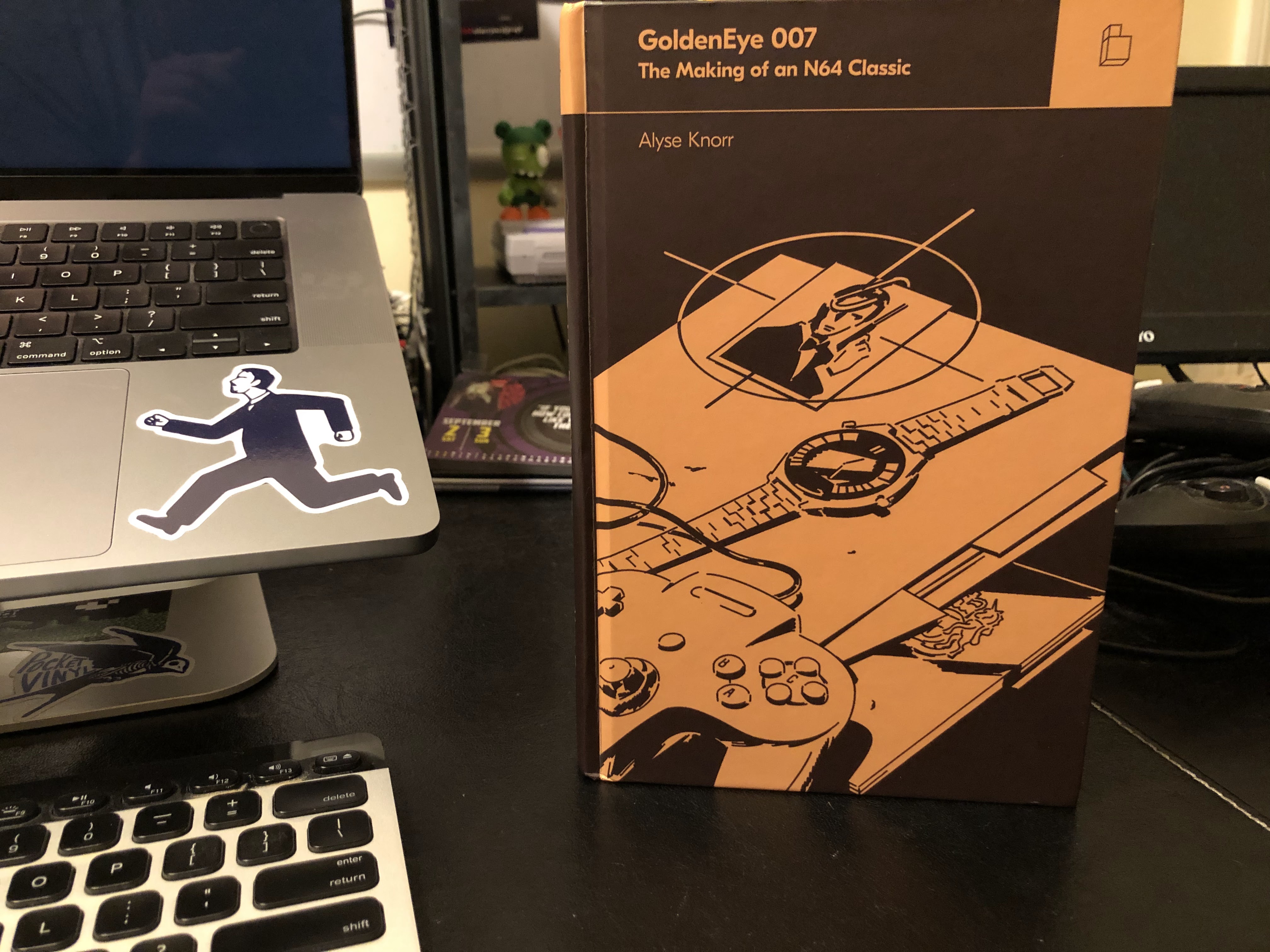
Probably my favorite cover in the entire Boss Fight Books series— Taken with an iPhone 8  
I was barely seven when Goldeneye came out on the Nintendo 64 and the only opportunity I had to play the game would not be until a few years later when I slept over at a friend’s house. We booted up the game in the late hours of the morning and, while my memory is a bit vague about what levels we played or whether his Dad rented or owned the game, we spent two hours having a blast in multiplayer. With the game now a part of the Switch Online games catalog, I was able to experience that same joy again through the single-player campaign…after I figured out the updated control scheme. Yet, it is the story about how the Goldeneye 007 game came to be which made me appreciate it even more with a recent addition to the Boss Fight Books lineup. 

Written by English professor, Alyse Knorr, Goldeneye 007: The Making of an N64 Classic is a book that provides an in-depth historical account into the how Rare developed one of the Nintendo 64’s legendary titles. There are two editions to this specific book—a regular paperback and a deluxe hardcover with design documents, pictures, and even a bonus chapter on how they developed the game’s soundtrack—and I backed the the latter during their Kickstarter campaign. No matter what edition you buy, Knorr’s in-depth account of both the game’s development and the James Bond franchise itself remains the same. Everything surrounding the Goldeneye 007 game gets through coverage—the history of Rare and Ultimate: Play the Game, what led to them and Nintendo claiming a license to Ian Fleming’s suave spy in 1995, the James Bond games which came after, etc—and the chapters dedicated to a specific aspect of development feel very much like an extended, behind-the-scenes feature for a film or television show. If you are wondering what the secret to Goldeneye’s memorable multiplayer was and how it came to be, or how they worked on the in-game models and animations, Knorr has you covered.

If you want to know how Grant Kirkhope and Graeme Norgate managed to make the iconic James Bond theme fit onto an Nintendo 64 cartridge, you will not be able to find it in the standard, paperback edition. It felt weird to me that there was a bonus chapter smack dab near the end of the book between the one on multiplayer and the other on the Nintendo 64’s struggles during Goldeneye’s development alongside how the team dealt with the violence in the game—with feedback from Nintendo and even MGM. The transition between them does not feel abrupt or awkward, but the absence of Kirkhope and Norgate’s contributions did not make any sense to me. If I instead decided on the standard edition, it would be the only setback to an otherwise well-detailed account.

The drawings, diagrams, and even reference photos do feel like a nice bonus feature with the deluxe edition. For someone like me who only had brief experiences with the game, it was cool to put faces to names, see how particular places and actors transitioned into in-game models, and how the menu’s manila folder UI developed into the file select and mission briefing screens. Players passionate about gaming history and development will be spoiled rotten with motion capture models, sketches of in-game areas, original design documents outlining what Goldeneye would be, and so much more. Both these additions and the bonus chapter combined make the deluxe hardcover feel more like the definitive edition of Knorr’s book, making it worth the US $29.95 price tag—double the price of the standard paperback at US $14.95.  

Even so, every edition of Alyse Knorr’s Goldeneye 007: The Making of an N64 Classic does the game justice in the same Boss Fight Books style—where personal narrative weaves itself with academic rigor. Compared to the other books I enjoyed—Matt Margini’s Red Dead Redemption and Gabe Durham’s Majora’s Mask—Knorr’s own experiences not only entwines itself into the stories of Goldeneye’s development, but compliments them gracefully. Her love for Goldeneye shows in both her personal experiences, and her own research and interviews with the development team. Anyone interested in the history of first-person shooters, gaming in general, or just fondly remember playing this game will find themselves with the perfect martini of a book—shaken, not stirred.   


In Sum: A love letter to a classic, late 1990s video game that goes above and beyond, but somewhat blows its cover with an extra chapter in hardcover that, while still thoroughly researched, would work better in both editions. Even so, it's a rich dossier—4 out of 5 Stars   

Boss Fight Books does sell the deluxe hardcover as an e-book for US $11.95 (at time of writing) in case you are interested in both the bonus chapter and the additional design documents, but do not want to shell out US $30 or prefer reading it in a digital format.   

28 July, 2023

An Updated Review Timeline and a Brief Amiibo Addiction—Ink for July 28th, 2023

Urban planning makes the best of geographic oddities. —Captured on Switch (Handheld Mode) 

I'm changing the timeline again with regards to rest of summer's reviews partly because of the usual culprit—although that's game's mostly wrapped up (for now)—but also because of one addition to the roster.   

I'm still working on reading through Goldeneye 007: The Making of an N64 Classic by Alyse Knorr and should still be on target to have a review written and published here next month. Islets will also be a review for late-August (or early September), but I'm also tacking on another game which evokes the same laid-back, summer feel. It also revolves around islands with a related namesake, Islanders: Console Edition, and was recommended to me by Ivenne, a friend of the blog and the creator behind the [Un]Official CheapShow Magazine! 

I'm aiming for somewhere between 750-1250 words for the combination review and there will be scores. (Spoilers: They're both fun!)   

As for the last item in the queue, I'm aiming to read and review The Good Luck Girls of Shipwreck Lane sometime in September.    

So that's the admin done, I thought I'd talk about what the Tears of the Kingdom shenanigans hath wrought... 

Top: A Solid Cast of Links—from the 8-Bit beginnings (rightmost) to when he composed music at sea (leftmost)—with a spider-esque robot lurking nearby.
Bottom: A Better look at the Windwaker Link & Zelda alongside the princess from her Skyward Sword days. —Both taken with an iPhone 8    

One of the things I didn't expect to do while playing this game was to break out the wallet for additional Amiibo figurines. These Amiibos have a Near-Field Communication (NFC) chip located at the base designed to interact with the NFC chip on a Joy-Con or an official Switch Pro controller to allow players to further enjoy additional features with particular games. In both Breath of the Wild and Tears of the Kingdom, they provide a cache of resources alongside a treasure chest containing either a normal weapon or shield, a gemstone, or an exclusive piece of armor related to the Amiibo in question.

Thing is, even if they said there was a restock on Zelda Amiibos upon the game's release, I never thought to take advantage of it. Then again, I wasn't really in the market for them beforehand—I had the 8-Bit Link one already alongside an 8-Bit Mario figure, the Metroid Dread dual-pack, and Mr. Game & Watch—since most of the games I played either didn't use them or had Amiibo-only features that I felt like I didn't need. The ones I already had were close to the regular retail price that the Nintendo Life article lists for the reissued Links (around US $14.99) with the exception of the Metroid dual-pack that was closer to US $30.

But when I found the Link from Majora's Mask on Amazon for around US $38 when it scalpers usually sell it for way over US $100, I can't say no to a figurine from what is my favorite Zelda game of all time! 

Here's the thing, you don't need these Amiibos if you're looking for exclusive armor and weapons in Tears of the Kingdom. You can find chests in caves and the Depths where you can net them without having to shell out money to a scalper or braving a games store as someone over thirty looking for what could be called a kid's toy. Without spoiling anything, the trek is worth it alone no matter how you end up finding them!

...and that concludes my Tears of the Kingdom ramble. Hope you all have a wonderful weekend!    

22 July, 2023

Red Team Blues—A Literary Fork in Proper Sterling

I love the book covers for Cory's books and this one is no exception! —Taken with an iPhone 8 
From Bitcoin to the Blockchain and Non-Fungible Tokens (NFTs), Web3 is a source of both fascination and scandal throughout the past decade. Yet much like the moniker itself—which advocates say is a fork of Web 3.0*—the concept behind these solely digital “artifacts” is a task that only becomes more complicated as one tries to break down and define them. With cryptocurrency in particular, there have been reporters who documented its history—Nathaniel Popper wrote an account on Bitcoin in his 2016 book, Digital Gold—but what happens when you put crypto in a fictional setting where the “coins” take center stage?  

Red Team Blues is the latest novel from science fiction author, Cory Doctorow, which is also his first foray into thrillers with a reverse-chronological twist. It is a book that gives cryptocurrency the coin toss into the world of fiction with the help of its main character, forensic accountant Martin Hench. He might have a monotonous-sounding occupation, but his career has been anything but courtesy of his “red team” approach—seeking the weak point in security systems in order to expose scams and frauds for his clients. While his career may have been low-key, this book shows him at his peak as he contemplates retirement from his $800,000 tour bus, the Unsalted Hash. Yet, he finds himself with one more gig for his old friend and client, Danny Lazer, who wants Hench to find some cryptographic keys lying around on a laptop's hard drive.

Even when he finishes that job, its not truly over and Hench finds himself under the threat of his retirement being whisked away.

Cyberpunk novels may suffer from complicated, technical prose for reasons that cannot be helped, but Doctorow managed to keep me in suspense without getting bogged down in jargon. Hench, may be more of a tell, don’t show person, but it keeps the narrative anchored and moving while keeping the technical explanations as simple as possible. Not for a moment did I feel lost in this book and having Hench and Lazer explain cryptocurrency in a discussion was a huge help—not just in explaining the concept in full, but how it drives Martin Hench’s career alongside Lazer’s. Everything that would otherwise be a complicated mess gets linked together in the closest thing to a graceful looking daisy-chain of cables.   

The same thing can be said for how this books lays out Martin Hench’s life, but substitute the shortfalls of cyberpunk with the lack of an info-dump deluge. Everything about Martin Hench’s life—his friends and personality—makes sense throughout the narrative with just his monologue and ongoing conversations alone. I ended up being invested in Hench’s personal relationships as he fought for his life and it made the ending even more satisfying.

 Red Team Blues is a novel that manages to provide a clear glimpse into the life on a forensic accountant in what would be the last book of a normal trilogy without spoiling too much, if not anything. Hench’s speciality in dealing with cryptocurrency helps break down what these “coins” really are without the need to scrawl through social media chatrooms and web forums, or reading historical accounts like Digital Gold. Both of these aspects make Red Team Blues into a book I would recommend to anyone who wants to give cyberpunk a fair shot.   


In Sum: If this were any sort of currency, it would be solid gold—5 out of 5 Stars

If you already enjoyed the book, or like Wil Wheaton, he does the narration for the audiobook! 

*Or some sort of fork from the World Wide Web whether it's Web 1,2, or 3.0.

28 June, 2023

The Shenanigans Won Out in the End...

Much like Return to Monkey Island, the uploaded screenshots won't do Islets any justice—Captured on Switch (Handheld Mode)  

Tears of the Kingdom has been my go-to game for the past couple months and, even if I did manage to do a playthrough of Islets in-between sessions, I don't think I could give a proper review to the indie metroidvania. I started writing a draft yesterday with an intro that (ideally) would transition from praising an open-world game for not having an overwhelming narrative to how Islets evokes a similar feeling for a metroidvania game, but it felt way too ambitious. It probably wouldn't make much sense either. 

I also made a post on Mastodon a couple weeks ago saying that I was on track for both reviews and, I admit, I got ahead of myself. 

In short, I'm pushing back almost everything...

  • I'll have a review of Islets up by late July, meaning that I can do a full playthrough on Normal and a more in-depth one on Hard
  • Red Team Blues will be a review for earlier in the month while moving Alyse Knorr's Goldeneye 007: The Making of an N64 Classic back into August. (Although it could also be a late July review as well...)
  • I'm still aiming for August to finish reading and review The Good Luck Girls of Shipwreck Lane for the blog alongside Knorr's book

Hope you all are having a great summer so far!  

23 May, 2023

A Glimpse Into What Summer Will Look Like This Year...

A in-depth look into the history of James Bond's Nintendo 64 debut, a cyberpunk thriller, and a Metroidvania that takes place in the sky— Taken with an iPhone 8

Sunday won again, but that was more or less me getting distracted by Tears of the Kingdom, which has been a beautiful experience that can sometimes be a little overwhelming. I'm not going to spoil anything here, but I did write a small thread on Mastodon with my initial thoughts on the game. The individual posts are all behind sensitive content filters, but the first one is spoiler-free and provides a window into my foray back into Hyrule. That, and it also highlights the way I played through Breath of the Wild along with how I approach open-world games.

I'll end up writing a few more posts on the game there as I play it, but for the next game review, we'll be going to a different set of sky islands!

Earlier into the year, I decided to sign up for the Super Rare Club, which is a service from Super Rare Games that more or less allows you to pre-order games earlier than the general public alongside a few other perks like exclusive merch. They are a company that specializes in physical games—like Strictly Limited and Limited Run—but solely focus on indie developers who might otherwise be overlooked. I've been a fan since I stumbled upon Project Warlock, which was Jakub Cislo's take on Doom that added role-playing game elements into the mix (plus magic spells). Some of my favorite Switch games are straight from Super Rare Games's physical releases—The Lion's Song and The Flower Collectors from Mi'Pu'Mi Games, Horace, Deponia (eventually in its entirety), and Dicey Dungeons to name a few. 

So when they announced Islets alongside the featured trailer, I thought that it would be right up my alley between the genre and an art style that fits itself gracefully between Hollow Knight and Monster Boy and the Cursed Kingdom. 

My plan is to do a run on easy mode first to get the full narrative experience while getting a feel for the exploration and gameplay mechanics. Then, I'll do a playthrough on normal to see how difficult the bosses and combat become to provide a (more) proper review. 

I'm aiming for late-June to write and publish the review—possibly July if I'm sidetracked by more Tears of the Kingdom shenanigans. (Although, I feel like I've made enough progress to take a little break.)  

As for the books...

There was a tie in the results between Cory Doctorow's Red Team Blues and Alyse Knorr's Goldeneye 007: The Making of an N64 Classic. I though that, instead of doing a tiebreaker poll, I would read and review both books starting with Red Team Blues and then doing Goldeneye 007 with the review for the former being slated for June. I'm aiming for July for the latter...

...and I'll also be doing a review of The Good Luck Girls of Shipwreck Lane in August—or July if I finish reading it before then. 

Thank you to everyone who voted in the polls! I think this will be an excellent summer for blogging! 

09 May, 2023

Hollow: A Love Like A Life—A Voyage Into Cosmic Romance

No glare and not as pixelated this time. Also, no overhead light. —Taken with an iPhone 8

Much like being around a crush or speaking in a public forum, I am very nervous about reviewing a romance novel for the first time. It is not even the just matter of it being outside of my comfort zone for my gender—Christine Sneed wrote some good novels which focused on relationships—but its something that I never even considered. I do not think it is a secret that love stories get a bad rap whether in literature, television, or film for presumably lackluster (or rather, generic) writing. Yet, this novel in verse has the power to change that paradigm while making my first journey into the genre go a little more smoothly than I thought.

Hollow: A Love Like A Life is a romance novel in poetry written by Jaz Jazalyn where two spirits, hailing from completely different universes, find themselves in love with one another. The laws that govern both universes, however, prevent them from properly meeting each other, which gives the illusion that their love is completely impossible. Yet, they still both yearn for each other and by the end, manage to make the best out of an improbable situation. It is not exactly a book with a happy ending, but their love is far from unrequited.  

I initially got myself lost at first, unable to make the distinction between the light and shadow spirits. I thought that it was similar to vVilrRuUsS: I Never Forget, where the lack of direction was intentional, leaving the reader to decided who the spirits are in each poem. Then I read it again and paid attention to the section titles. This time, the sense of confusion faded out between the sections “Dreaming of the Light” and “Dangerous Skies”. The distinction is made clear, even if only for a brief moment, and the shadow spirit provides some clarity as to how they fell in love with each other in the poem “Strange Eve”. Their romance may be forbidden, but fate works in strange ways no matter what universe one resides in.

Once these sections pass, the difference between light and dark is rendered unclear once again as they become more enamored with each other. There is the spark of inspiration, the wish for a chance to meet, the encounters within their own dreams, followed by intensifying feelings that prompt both jealousy and doubt between the spirits. All things which, in a reality-based romance novel, may be symbolized by antagonistic characters, unfortunate accidents, and strict families among other things. Yet, there is little mention of those aspects in Hollow, which added to the tension to their relationship and lack thereof.

An aspiring reader may wonder how these spirits manage to maintain a strong bond if they cannot communicate across universes. Much of it comes across as inferred telepathy, and one poem titled “Infinity” suggests that one does end up imitating the other. Another set of poems near the end of the novel suggest that their telepathy ends up manifesting itself through text messages and social media posts. This would be the closest thing to them properly meeting each other, meaning that whatever secret language they use evolves throughout the narrative. It may not make sense, but Jaz Jazlyn puts the same level of ambition into making their relationship work as she did to ensure that no account was left behind in vVilrRuUsS’s large-scale apocalypse. That level of dedication makes this supernatural love story into something both emotional and heartwarming.

Jazalyn’s proper romance novel also comes with some solid, inspirational pieces of verse, One of my personal favorites is the poem, “I Changed After Loving You”, where the spirts reflect on how their chance encounter inspires them for the better. I feel like this idea could apply to any relationship or long-lasting friendship where meeting them carries that very same effect. Even if things do not end up working with the person that they like or were friends with, that initial impact is the potential driving force for something better especially if they look solely at the positive. For the spirits, this reflection only renews their faith in each other regardless as to how many universes divide them.

The other poem that personally stood out was “Who I Really Am”, in which the spirits promise to be completely honest with each other—flaws and all. I feel, in a universal sense, this is the most difficult and nerve-wracking thing to do, even if your ideal self in a relationship is your genuine self. I think part of it also comes from fearing disapproval not just from partners but friends, co-workers, and family as well—even for the simplest of differences. These anxieties do not bother the spirits since their genuine honesty acts as a sort of buffer for the emotional intensity they experience as their relationship develops.     

From a novel on self-love to a full-on romance in poetry, Jaz Jazlyn captures the reader’s heart through her ambitious tale where light desires an encounter with shadow. These spirits carry that determination throughout Hollow: A Love Like A Life to ensure that they can reach some sort of happily ever after—even if the path there is somewhat meandering. It is a love story may be a better fit with Neil Gaiman’s books than with other romance writers, but this cosmic, sentimental tale stands on its own with each verse lighting the night sky as part of a constellation.  


In Sum: Not a Bad Start to a Cruise Across the Stars—3.5 out of 5 

Hollow: A Love Like A Life is available through book retailers including Barnes & Noble and Amazon.   

08 May, 2023

Outside of the Literary Comfort Zone—Ink for May 8th, 2023

Last weekend, I wrote that I would be doing just one review for the week and that would be, well, it. 

Instead, I decided to read through the second of three and belt out another review for Thursday and bumped vVilrRuUsS: I Never Forget to Tuesday morning. Rose: Future Heart, I think, is the first time I reviewed something in the romance genre—or close to it anyway—but Hollow: A Love Like A Life is the real test. Whereas Rose: Future Heart was a journey of self-love and empowerment, Hollow is more of proper, supernatural romance between two spirits.

So I'm fully venturing outside of my literary comfort zone for this one, but not unprepared...   

I asked a friend of mine what they thought made a good romance novel and they gave me some very solid points to work from. I felt like those qualities could also act as a narrative framework for what I'm looking for with Hollow: A Love Like A Life. 

Like last time, I plan on aiming for Thursday or Friday since, while the books may be challenging to critique, the format that I set up for them works amazingly well! 

Admittedly, I'm also doing some research on my own based on my friend's advice... 

A couple of weeks ago, I checked the mini-library I usually pass on my walks to see if they had any romance novels I could study from and decided on what I thought was the closest facsimile: The Good Luck Girls of Shipwreck Lane by Kelly Harms. Both the title and the premise gave me Return to Monkey Island vibes and with Shipwreck being more of a rom-com than a straight-up romance, I could still look for some of those same key factors but in a more familiar genre.  

I'm not sure if I'll rank it on Goodreads since I'm not the book's intended audience, but I do plan on reading that one to the end. Maybe I'll give a proper review on the blog, but I'm not sure about that yet. 

Okay, that's the admin done with...


The video of the week goes to John Rodgers for one of his recent adventures alongside the River Brent. He's become a sort of go-to channel for my post-work Sunday afternoons with his walks across London, and even Paris (although I feel like he's done more than that), which I find very relaxing. He has a way of bringing tranquility to the city's heavily populated streets, making even the most mundane bits of architecture shine with historical relevance.    

Those familiar with CheapShow will be no stranger to one of the locations featured during the video. It was actually through their live show for episode 300 that I learned who Rodgers was during their YouTube parody intermission, (I caught Paul mention his name in the live chat.)  

John Rodgers also has his own blog, the Lost Byway, in case you're interested in reading more from him.

Other Videos I Watched...
Other random links...

Hope you all have a great week!

04 May, 2023

Rose: Future Heart—Love's Labour's Hope

Mostly glare free, but slightly pixelated. It is a nice cover though. —Taken with an iPhone 8

Love. It is an overwhelming concept for some and a highly sought after notion for others that gets constantly debated and explored. Universally, it could be a little bit of both—at least I think so anyway—but is there a strict definition of what that sort of affection or passion could be? There is a book out there, which helps answer this particular question… 

Rose: Future Heart is another poetry novel from Jaz Jazlyn, which follows a Rose personified as a woman as she deals with her own internal conflict about how she views and experiences love—both as interpersonal intimacy and as a source of self-motivation. This personal clash between seeing herself as an independent person who rejects romance and as someone who desires affection plays out throughout the poems and—unlike in vVilrRuUsS: I Never Forget—these poems have a clear link between one another. This is another great stylistic choice by Jazalyn who wants the reader to know about how the Rose deals with her initial resentment about love and how she transforms that into a form of self-empowerment.

To call this a book of mere poetry cliches does this novel a disservice as some of the poems and verse allude to a deeper trauma. Once the Rose realizes where her psychological pain stems from, her voice becomes more grounded and confident with the verses becoming more orderly by the novel’s end. She is fearless in noting similar cases in the poem “The Criminal Country” with this revelation and it fits right into the narrative. For me, this realization that made Rose: Future Heart a poetry novel worth reading for the depth of both the poetry and storyline.

There are many notable poems in Rose: Future Heart, but admittedly I enjoyed “Entertainment Made Me Love Like That” where the Rose examines how her desire for romance stems from music, television, and film. It is not a long poem—and it could be considered cliched for its critique of showbiz—but I feel like it can be considered a universal feeling, considering how many stories carry some sort of romantic subplot. Later on, the poem “Love is not Entertainment” acts as the Rose’s realization that love is not just about intimacy, prompting her to think about what her own definition of love is.

There is another set of connecting poems, “Silent SOS” and “Me No — Know Me”, that I enjoyed partly for that fact alone. The distance between the poems allows for the link to act like a left-hook since, in “Silent SOS”, the Rose shouts “Me No, Know Me” as a means to keep rejecting romance regardless of how it would aid her. This saying in the namesake poem gets directed at a person who is highly unkind to the Rose and helps in shaping the revelation which comes later. Both these poems reinforce the narrative’s focus on the Rose and allowed me to appreciate how she deals with her internal struggles to come out empowered by defining what love is for herself.

While it is not a conventional love story, Rose: Future Heart is a poetry novel about how important it is to love oneself while not letting others define what the word means to you. Jaz Jazlyn does an almost impeccable job at illustrating the Rose’s personal battles with the concept, from resistance to acceptance on her terms. Even if you are not the usual audience for anything romance related, this book could help motivate you to steal your heart back from cynicism alongside your own traumas.


In Sum: A Romance, in which the self becomes the love interest, and deconstructs the idea into something greater—4.0 out of 5   

Rose: Future Heart  is available through book retailers including Barnes & Noble and Amazon.

02 May, 2023

vVilrRuUsS: I Never Forget—An Apocalypse Full of Ambition

Sadly, I couldn't get the coffee cup in shot this time. Glare mitigation took priority. —Taken with an iPhone 8

One of my favorite scenes in Douglas Adams’s Hitchhiker’s Guide to the Galaxy, is when Arthur Dent and Ford Prefect find themselves at the mercy of Prostetntic Vogon Jeltz who makes them sit through a poetry reading before they get shoved out of an airlock. It was funny to watch the reactions of both the mostly non-plussed Arthur and writhing Ford, but it also made me appreciate how science fiction could change the way one saw the world through the power of comedy. Decades since the publication of my favorite novel, a new author by the name of Jaz Jazalyn seeks to do the same thing, but instead of comedy, she does so through the power of verse.   

 vVilrRuUsS: I Never Forget is a poetry-driven, fiction novel where three distinct viruses infect the masses throughout the course of what could be considered a long apocalypse. The first one sets the stage by making everyone criminals in one form or another, while the second messes around with people’s memories, and the third one could be considered the panacea that protects the survivors by enlightening them on the past. 

This is probably the best interpretation of events as the poems lead themselves into discussing civil unrest, what it means to love and be loved, the definition of God (at least, presumably in the Christian sense), the state of mental health, and a few other topics. In a way, it is like Jaz Jazlyn covers the stories of everyone impacted by these viruses, meaning that no account is left behind. Even with no proper protagonist, Jazalyn makes up with the world-building alone, verse by verse.      

As I read through the book, I could not help but feel slightly lost in-between viruses. If the gap between pandemics was long enough, it started to read as more of a poem anthology than a poetry novel. Considering the novel’s ongoing apocalypse, this may be intentional and that the reader might also be infected by proxy. If Jaz Jazalyn did plan out the novel with this idea in mind, that sort of artistic ambition makes this book worth the read alone. 

My personal favorite from this novel is a poem called “.M.A.C.H.I.N.A.T.I.O.N.S.” where the words form themselves into something resembling a hat. At the hat’s peak, the words make the it look like it has a plate attached to it and what slips into the hat, well, does not exactly bode well. It reminded me of the idea of a “tin foil hat” on first impressions and one could easily think it has conspiratorial roots. Considering the first words that get fed into the hat, I thought so too, but with how these viruses impact the populace, it might not be the case. It may be that survivors, both infected and clean, are trying to figure out what kind of world they are living in by patching available memories together. 

There is another poem of note shortly after “.M.A.C.H.I.N.A.T.I.O.N.S.” titled “Of the Trash” that had a sort-of cyberpunk feel to it. There is an unknown group that is all-knowing, all-seeing, and all-powerful, and the speaker seems to be rallying people against it by calling out every presumed injustice. It does feel similar to the way some cyberpunk novels involve a drastic power struggle between the affluent and the working class, but that is about it. In a way its a sort of turning point in the novel where the masses are now aware of the multiple pandemics.

 vVilrRuUsS: I Never Forget is an interesting science fiction novel in verse, where chaos exists in both the world and the text itself. It may be a hard sell for those who are into the typical apocalypse novels, cyberpunk thrillers, and dystopian literature, but this is far from Vogon poetry. If you are looking for a unique science fiction experience, or just enjoy a good set of poems, Jaz Jazalyn has you covered. 


In Sum: Artistic Drive meets Dystopia Mayhem—3.5 out of 5

vVilrRuUsS: I Never Forget is available through book retailers including Barnes & Noble and Amazon.   

28 April, 2023

One Book Down and Figuring out how to Review Them

I finished my first read-through of Jaz Jazalyn's vVilrRuUsS: I Never Forget and, as I was typing out a small write-up for Goodreads, I feel like I have a format figured out. 

So here's what I'm thinking...

  • Each individual review will be around 350-650 words.
  • I'll highlight my favorite poems and what makes them stand out from the rest—of course, without spoiling the text.
  • I'm not going to go (super) in-depth with the poetry analysis, considering that they're also fiction pieces. 

I feel like this should help with providing thorough reviews while keeping me from stressing out too much or overthinking things. That, and it'll probably be better than just slapping a huge post with three reviews, giving me a little more time to pace them evenly.

I'm still poised to do a weekly post for Sunday, so do look forward to that! Hope you all have a great weekend! 

26 April, 2023

How Sunday (Almost) Wins Every Time, Along with More Book Talk—Ink for April 26th, 2023

I want to get into a habit of at least writing out one post for Sunday, like the one I did before doing the Axiom Verge review. So I started writing out the previous post on Sunday with the idea that I would do a little link list like last time—with this one being slightly more audio oriented than the other one with both new pods and music.

I think between laundry day, assembling a new hamper in between loads, and not brewing a tumbler of caffeinated tea after work (either Yerba Mate, or Twinnings English/Irish Breakfast), I didn't realize that I ran out of energy. I got to the point of trying to explain RoadQuest before drawing a complete blank and calling it a night. 

The next day, when I did get around to writing Monday's post, I thought that the new direction it headed was better than what I initially outlined mentally. 

I think for now I'll stay on the literary train and keep it brief for now. Here's a video I watched a few months back from Rebecca Watson's second YouTube channel (Rebecca Vs. Life), in which she reviews William Gibson's Neuromancer...

Admittedly some of the best cyberpunk work I've experienced outside of reading Cory Doctorow is via different mediums. The original Ghost in the Shell film from 1995 was technically my first introduction to the science fiction sub-genre around my junior year of high school. Then, when I discovered Doctorow via a former co-worker, that was also when I watched a playthrough of a game called Snatcher that was part-thriller and part-mystery. Post-college, it was the film Akira along with playthroughs of Read-Only-Memories and VA-11 Hall-A, then the film Blade Runner, and eventually reading Neuromancer.

I'm with Watson on this, and I find that dense, technical prose is what makes cyberpunk a bit of a hard digest. The issue isn't just restricted to Neuromancer since I got the same vibe from Read-Only-Memories at times and I enjoyed that game for the setting and characters alone, and some of Doctorow's own books read similarly.  

A lot of the titles mentioned that are easier to comprehend usually lean towards thrillers, which isn't a bad thing, but some of them lean into old action movie tropes—or the closest facsimile to them anyway. It's far from a deal breaker for me, but it makes them harder to suggest to anyone who is curious about this little niche of sci-fi. 

Me? I might be biased in my recommendations, but Cory Doctorow is definitely a good cyberpunk author to start out with—Makers was the book that got me hooked on his work and Little Brother is excellent for those into Young Adult Literature.   

I would also consider the game, Hypnospace Outlaw, to be cyberpunk in part due to its setting and presentation. At the same time, it's partly a parody of the late 1990s Internet and Microsoft along with being an alternate history game, making everything click together gracefully without having to piece together strings of technical and philosophical code.

Of course, Read-Only-Memories also has my seal of approval and, without spoiling anything, references Neuromancer. 

I also believe, that Jaz Jazalyn's poetry novel, vVilrRuUsS, would fit into the definition of cyberpunk. That's currently the vibe I get as I'm reading it.

Watson did a follow-up video with a review of another Gibson novel, Virtual Light, which sounds promising. I feel like its another book to add to my to-read list, and possibly put Gibson into my list of favorite cyberpunk (and sci-fi) authors.


That's it for now! Hope you all are having a good week!

24 April, 2023

A Slow Journey Back into Literature—Ink for April 24th, 2023


There are two other books I've been juggling both pre-and-post Little Book of Sound Chips—Suzanne LeBlanc's Cassiar: A Jewel in the Wilderness and Richard Moss's Shareware Heroes. The former of which I started reading about a year ago when I did a search for Cassiar, British Columbia on the web. This was a little bit after I watched the above episode from LoadingReadyRun's Road Quest—a show in which some members from the LoadingReadyRun crew take a cross-province trip from Victoria to Dawson City, Yukon, partly inspired by the grand-scale trips from UK's TopGear. (...and The Grand Tour by proxy.)  

Frequent readers will already know of my love for this comedy troupe turned video-production house and the impact they had on me personally throughout the years. This RoadQuest episode, where they make a brief detour to where Cassiar used to be, would be no different and then some.

It's an episode that has inspired me to start out a new writing project, shortly after my new laptop arrived in the post. So I thought that it would be best to try and find more information about the abandoned mining town myself to ensure that it gets accurately represented. Or in the case of a science fiction comedy novel, accurately represented and properly honored.

Of course, getting back into video games hasn't helped my reading much, if not at all. Even if it lead me to my first paid writing piece, it's hard to focus on other things as I noted in the Little Book of Sound Chips review. In short, it has to be all about the console or computer and the game one decides to play. Although with the Nintendo Switch, I can sometimes get away with putting a podcast on in the background with games like Stardew Valley or Legend of Zelda: Breath of the Wild where the music, sound-effects, and even some voice acting* can be a little too repetitive at times. 

Last summer, when I started walking to the restaurant, Puffins, for lunch, I would usually take a couple books with me. One of those books was Cassiar: A Jewel in the Wilderness and I remember belting through a few chapters...at least one per outing before my food showed up. I may do a brief, travel blog-like entry on the place since the food and company are both great. The organization that runs Puffins, Seabird Enterprises, helps those with physical and developmental handicaps find and maintain employment so the money does go towards a good cause.   

But I digress, and when last fall arrived along with Persona 5 Royal I would completely forget about finishing the foray into Canadian history. Weirdly enough, I started reading through a couple of manga books shortly after beating the game—mostly JoJo's Bizarre Adventure (Part 4) and Fist of the North Star. It was that brief binge, alongside going back to Mastodon, which prompted me to add the Little Book of Sound Chips to last year's poll. With the book being the winner, I thought that I could use this book review as the first step to get myself back into reading proper.

Slowly, but surely, it is. I think that Jazalyn's three books will also aid this immensely. 

Audiobook-wise, I'm listening to Chokepoint Capitalism by Cory Doctorow and Rebecca Giblin. It is a book which deals with how artists, musicians, and content creators at large inherently have become dependent on Big Tech, like Spotify and Amazon, alongside how those very same companies mistreat said creators. I'm almost at the point in which both Doctorow and Giblin outline solutions to mitigate the companies "flywheels" as they call them to ensure that content creators get their proper share of royalties while also making the creative market more competitive. I'm excited to see what they propose!

I have to admit that audiobooks have also helped in aiding this road back to literature between new reads, like Lindsay Ellis's Axiom's End and putting on a couple of Douglas Adams's books when rough work days happen. I've had them in the background during some gaming sessions as well.  

Either way, you could call it a "Book Quest" from gaming's Mememtos to literature's Ursa Minor Beta!

*This isn't true for Breath of the Wild, which is perfectly playable without a pod or audiobook for the game's serene atmosphere and minimalist score. Sometimes, Persona 3 & 4 do fit that bill of repetition though.

22 April, 2023

An Unexpected Opportunity

I know the titles are a little pixelated and somewhat hard to read, but it was the best way to get all three of them on-screen. That and admittedly, I like getting a coffee mug or tumblr in shot. —Taken on an iPhone 8

So I started the week off by saying that I was going to buckle down and write out the Axiom Verge 1 & 2 review, which I did and much earlier than I expected too. Part of that reason was because, on Monday morning, I received an e-mail from an indie author who wanted me to review her poetry novels.

To which, I replied, "Yes!" I also did mention the review I was working on, more or less to ensure that I could dedicate my time to giving these books the proper treatment. A little over an hour after I posted the Axiom Verge review, she sent them over...


So Who is the Author?

Jaz Jazalyn is a writer who specializes in both fiction and poetry. The three works in the photo above are hybrid novels which combine the two—with the each poem driving the narrative forward. 


What books did she write? 

vVilrRuUsS: INever Forget—a dark science fiction novel in which viruses wreak havoc on humanity, causing some to become criminals or even mess with their memories. 

Rose: Future Heart—a dark fantasy, romance in which a rose, personified, attempts to overcome her own past to forge a promising future.  

Hollow: A Love Like A Life—a supernatural romance in which two spirits, one from a "light" universe and the other from a "dark", are infatuated with one another but cannot be together due to (presumably) the laws that govern said universes. So they figure out ways around those restrictions.

(I should note that each of these brief synopses are a paraphrased combination of the briefs she sent in her e-mail plus the blurbs on Goodreads.)


So how will the reviews work?

They'll be similar to how I did the one for the Little Book of Sound Chips: Volume 2—admittedly, I still need to update my Goodreads and StoryGraph entries for that one. 

Unlike that book, these reviews will be shorter but I'm not sure yet as to what the minimum word count might be. I may combine them all into one huge blog post while doing each book individually for the literary socials.

Which means that I'll have an order in which I can complete them in, starting with vVilrRuUsS since sci-fi is definitely within my comfort zone. I'm not sure about the other two yet. I may follow the above list or I might just do Hollow first, but we'll see once I finish the first book.


What I can say for certain is that I plan on reviewing these all within the month of May! Keep your eyes peeled and thanks again to Jaz Jazalyn for the opportunity!        

19 March, 2023

The Little Book of Sound Chips Volume 2: An Audio Powerhouse in Book Form

A second installment that fully embraces the chiptune sounds from across the Atlantic (and beyond)—Taken with an iPhone 8

Note: While the book's presentation is unique, I'm not keen on sharing photos of individual pages. Instead, I embedded some YouTube videos which highlight tracks and demos featured in the book itself.   

As gaming becomes recognized as mature medium for both its artistic merits and value in entertainment, scholars and enthusiasts are doing their best to document many early milestones. There are companies like Digital Eclipse who come out with fantastic anthologies, allowing the player to experience older games almost seamlessly via emulator while letting them comb through old manuals, box art, and even interviews with the developers themselves. Non-profit organizations like the Video Game History Foundation alongside hobbyist initiatives like the Retro Collective in Stroud, United Kingdom do similar work—hosting interviews on their respective podcasts, restoring microcomputers and scanning video game magazines for visiting patrons and scholars alike, and backing up ROM files as a means of preserving gaming history among other initiatives. 

When it comes to books, the Retro Collective’s Neil Thomas (RMC-The Cave on YouTube) has transcribed his podcast interviews into books form while Boss Fight Books works on weaving literary analysis and historical anecdotes with personal narrative in their ongoing book series. French book publisher Geeks-Line and Jeremey Parish catalog gaming consoles and their associated back catalog, condensing the work of the above groups into another digestible form. 

The trouble with these books is the fact that…well, they are read-only for a medium lives and breaths on player inputs. That and, if you are like me, then you may be wondering how you can at least experience the music from these games. This is where Chris Abbott and Andrew Laggan come in with their Little Book of Sound Chips series. With these books, technical documentation meets a museum formed from pages—whether you are flipping through the print version or surfing through the digital version dotted with hyperlinks. Published by the minds over at FusionRetroBooks, these books are gaming at not just a glance, but a radio broadcast clear of static and full of chiptune goodness. What makes this even better is these books are easily affordable—Volume 1 comes to £9.99 or US$12.17 while the second installment costs £14.99 or US$18.26 (currently on sale for £7.50 or US$9.13 at time of writing)—so you do not need to shell out a good chunk of your paycheck to experience what makes video games memorable.        

I backed both the first and second volume when FutureRetroBooks hosted their campaigns—and it was the second book that incentivized me to fully support this line of literature. My earliest moments in video games include the time when I accidentally pressed the eject button while my Dad played through Yoshi’s Island alongside all the moments I spent at a family-friend’s house playing Banjo-Kazooie, Mario Kart, and Mario Party, which in theory, would make me more inclined towards the third or fourth installments. When you discover the SID chip through a Canadian comedy troupe turned video production house and Paula through the many Amiga enthusiasts on YouTube, this makes it a different story.

The Little Book of Sound Chips: Volume 2 was the book I had most anticipation for where I could finally figure out what makes SID, Paula, Ricoh (NES/Famicom), and Yamaha (in the form of the YM2151) tick while also highlighting other arcade sound chips alongside more obscure ones. Some of the technical descriptions were slightly difficult to understand, but those who are well-versed with music and computer processing will appreciate the attention to detail. The brief glossary at the beginning of the book made much of these passages comprehensible without making me feel lost or lacking in knowledge—even if some of the jargon still seemed dense at some points.

This focus on the technical aspect of these chips is far from a setback in what is a great foray into video game history. Abbott and Laggan clearly want to make a book on music history in gaming for both computer-savvy technicians and those who fondly remember cruising down the beach in Outrun with “Magical Sound Shower” or “Passing Breeze”. For the latter crowd, the highlight comes in the form of myriad pages after the technical introductions and background history. Each of these sheets consists of the game’s title followed by a small (sometimes cheeky) description, a picture of gameplay, and a QR code. If you have a smartphone or tablet at the ready, these codes are a gateway to a YouTube video where you can hear the sound chip in action—and more importantly the soundtrack of said game. Sometimes, there is some gameplay included, especially with some of the Commodore 64 and Amiga titles, making this book into the afermentioned museum that I personally did not expect while reading through it.

Thing is, soundtracks are only a portion of what makes this book a solid entry about gaming history. Going back to the technical descriptions, you sometimes get a historical overview of the composers who took advantage of particular sound chips like with Rob Hubbard, Ben Daglish, Martin Galway, and many, many others who took advantage of both the SID and Paula chips in order to create soundtracks that made even the badly reviewed games worth playing. Missing these because the technical rundowns might be slightly difficult to comprehend takes a chunk out of what (and more importantly who) makes these soundtracks into something groovy and memorable. 

Same can be said for the brief introduction into the Amiga demoscene and the chiptune music scene that the Nintendo Entertainment System’s (Famicom’s) Ricoh 2A03 inspired. The way these composers use said sound chips among many others to create unique numbers is one of the driving forces behind electronic music—and in some cases dance music—making this book into a historical powerhouse. Without Ricoh, you would not have the likes Jimmy Hinson (Big Giant Circles) or Anamanaguchi, nor would you have soundtracks from composers like Shovel Knight’s Jake Kaufman or Cecconoid's H0ffman. With the QR code sections usually ending up with homebrew games of demo tracks, the respective music scenes only add to an already excellent showcase with spice and amplitude.

The biggest issue this book has come down to the possibility of link rot because these videos are all hosted on YouTube. It is unclear if, or when, these videos may be taken down because of a DMCA copyright claim, which is not the fault of the writers. That is a larger problem for both gaming historians and composers (professional, indie, and enthusiasts alike) to solve over time alongside larger parties—both in politics and tech. Of course, you can always search for the soundtracks and demos on YouTube by keyword, but the varying results might give you the wrong track (or the right track, but the wrong sound chip). For now, the QR codes work continuing to make this book sing with every audio chipset.

I do have one piece of advice though: If you want to scan the QR codes, you might want to make use of your tablet instead of your smartphone. Since it does not open with the YouTube app, but in a separate webpage, the play button is small. If you pause it, you might end up hitting one of the suggested videos unintentionally.

Otherwise, The Little Book of Sound Chips: Volume 2 is a tome of happy listening that both acts as a gateway to nostalgia and a portal to gaming history. Whether you are a retro gaming enthusiast, music composer, or even just love music for the sake of it, this book will sit proudly either on your shelf or your coffee table.   

The songs and documentation speak for themselves. No additional tuning required. 5 out of 5 Stars.

17 March, 2023

A Brief Update and New Reading Haunts

I'm just writing in to say that I haven't forgotten about the blog, nor have I neglected to read through the Little Book of Sound Chips: Volume 2. I finished the book and I started work on the review last Saturday, but have yet to finish and refine it. I'll do my best to aim for early-April, work and life commitments permitting.

(Admittedly though, a nostalgia trip through Tales of Symphonia plus the other two Persona re-releases doesn't qualify.)

I am also trying out two new Goodreads alternatives—BookWyrm and StoryGraph. The former is a decentralized, open-source equivalent that uses the ActivityPub protocol meaning that you can also follow my reviews over on Mastodon without having to sign up for a separate account on a new service. The latter, on the other hand, is a more in-depth version of Goodreads that is properly independent (as in, not owned by Amazon) that allows users to give half-stars in their reviews, mark books as did-not-finish, along with many other user-friendlier features I have yet to read about. 

The shorter version of the review will still be on Goodreads alongside these two services. You can follow me on both of them...

StoryGraph: @prompted_ink (requires log-in*)

BookWyrm: @PromptedInkReads

The only thing I'll note here is that the import for both of them was almost seamless—StoryGraph was not able to find one book out of the many while there were several lost entires on BookWyrm. Not a major deal in any way, but it's something to keep in mind in case you're wondering why a few titles and reviews are missing entirely. 

Outside of that, I've been way more active on Mastodon, even if its just boosting others' posts. I did a entry about it on there through a quote boost and, even with current events being what they are, checking on Mastodon does not feel like doomscrolling. I sometimes think that Twitter has made us more cynical and charged in particular ways that have been detrimental to our mental health and public discourse overall. The same thing could be said about Facebook, which in hindsight was another reason why I left there in 2015 and fully deleted my account the year after. 

What I said before about Twitter still stands, for now anyway. I'm looking at ways in which I can replace the Twitter embeds so I can avoid link rot as best as I can. The ones with my tweets are not difficult to replace—some require only a photo and a caption while others require me to make a proper collage out of four photos**. The one's that don't may require a link to the blog on the Wayback Machine. 

That's it for now! Have a great weekend and Happy Saint Patrick's Day to those who celebrate it!