13 April, 2023

There Would've Been a Top 10 Games List for 2021, but I Let it Woosh By...

My Game of the Year for 2021, plus an example of one of my better action screenshots. —Captured on Switch (Handheld Mode)

Note: There's early spoilers for Eastward in this post. This is a game I recommend playing blind if you're into a top-down, Zelda-like experience for the story alone. 

So last year, I had this idea of doing a personal top ten for my favorite new Switch games for 2021. Some of my own rules included that I couldn't places games on there that were already released on different platforms, meaning that Shin Megami Tensei III: Nocturne and Disco Elysium: The Final Cut would be honorable mentions. 

Here's what the top five would have been...
  1. Eastward
  2. Metroid Dread
  3. Shin Megami Tensei V
  4. Axiom Verge 2
  5. Cotton Reboot!  
There's a nice combination of well-known franchises—one unexpected comeback and another with four years in the making—a full-on remake of a classic title, a sequel to an well-received indie title, and another indie game that blew me away.

Developed by the team at PixPil, Eastward was one of the options in my first poll to decide which game I'd review for the blog. It was a game that started gently, in which Potcrock Isle's resident miner, John, and his adopted daughter, Sam, lived an almost quiet life in an underground enclave. Fellow residents feared what wonders existed on the surface with an air of conspiracy, and would openly shun those associated with anyone who dared to set foot on the forbidden soil (whether by choice or not). Even worse, in John and Sam's case, wandering around an abandoned grocery store which coincidentally leads there is a one-way ticket on Charon.

Yes, Charon, but also not exactly. John and Sam are merely exiled into the rest of the world which has managed to make a niche for itself with boats substituting as dwellings and an entire city sitting on the side of a dam. The game's art direction does the game's world justice in a way that my brief descriptions never could—reminding me of both the old Mario & Luigi role-playing games alongside the Secret of Mana—and Joel Corelitz's soundtrack adds just enough spice (and 80's-sounding synths) to make that eastbound journey worthwhile.       

For me, Eastward, was a game that felt very character driven with John and Sam at the helm. Even the world-building integrated itself around the conceit. Having the entire setting almost play second-fiddle works in this game's favor, and I don't think that I can say that of many games. Not to my knowledge anyway. 

Part-Roguelike, Part-RPG, and slightly more significant than this screenshot leads on —Captured on Switch (Handheld Mode)  

What made this even better was one motif: Earthborn. A game that you could play in-between tasks. A in-game television show, which seemed to be the only thing on air anywhere—even on Potcrock Isle. A cultural phenomenon that is highly revered by the characters who grace Eastward, both major and minor.

It gave the game an extra layer of literary depth and without saying too much, they make it work spectacularly!

That, and it helped make Eastward into an ambitious package that managed to make everything work in an almost-perfect state of synchronicity.

Too early of a screenshot to be used in the review proper, but it works as a transition...sort of. —Captured on Switch (Handheld Mode) 

Enough rambling about Eastward though...

The idea ended up being forgotten, but in hindsight, I'm glad that it actually didn't come to fruition. Replaying through both Axiom Verge 2 and Shin Megami Tensei V (a little after I reviewed it) made me think that their placement on that list was wrong.

I feel like it could be explained better like this: I ranked Metroid Dread below Eastward because, while Dread was an action-packed tour-de-force, it was mostly familiar territory. In this case it's far from a bad thing because of the fact that the game felt exhilarating. That feeling helped in preserving the nostalgia I had for the series while giving it a newfound respect for the work put in by the developers.  

It of course helps that Dread had a solid story to reinforce the gameplay elements, but the same cannot be said of Shin Megami Tensei V. I noted that the game's allegorical story was very weak in the review, since it seemed to favor one side over the other. The battles, and the pseudo open-world gameplay held the game together, but on a new game where you can keep all of your old demons, the whole thing does not hold up the second time around. 

Axiom Verge 2 does, and I'll let the eventual review explain itself and why I now want to place it in my top three for 2021. 

Until then, I have two words: third playthrough. 

08 April, 2023

Back to Where I was Going, and this time, it will be Done...

It's an observatory, but not one operated solely by the microcomputer on the right. Also, Universes... —Captured on Switch (Handheld Mode)  

After months of putting it off and then deciding to deviate to a book review, I find myself back here again. A part of it is me finding solace in both games last weekend in a strange moment of serendipity casting aside my initial weekend plan of watching MsMadLemon review a Linux laptop, which I ended up watching on Monday instead, alongside someone else's playthrough of Final Fantasy XII: The Zodiac Age. 

There's also the excuse that my physical copy of the game came in the post right before I headed up to Boston for my sister's commencement ceremony, but I'm not counting that coincidence for reasons that I feel go without saying. 

But I think it was when someone recently asked me about what makes me a perfectionist—or something along those lines—that I actually pulled back and took a look at what I was trying to do. 

I don't think I've ever wrote about my review-writing process at length, but here's what I do regarding video games:

  1.  I transfer the screenshots from the Switch to my iPhone and ultimately AirDrop them on my computer.
  2. I create a Scrivener file using the lecture template, drop my screenshots into the "Research", and summarize the review in the main body's sidebar.
  3. Usually, because I'm not the best at intros, I'll jump straight into talking about the game—what it's about, what makes certain aspects compelling like the gameplay and story, and what's lacking (or what it could do better).
  4. Then I work on the intro where I, currently, use my nostalgic ramblings or weave the game's themes into the review proper. That and the conclusion. 
  5. Somewhere between Steps 2 and 3, I'll rename the files where I save the screenshots—said captions are more or less would be brief Alt-text describing the action onscreen with the occasional joke*. Here, I decide which ones will be featured on the blog.
  6. Review gets pasted into Blogger, screenshots follow, and then there's the final read through with minor edits.
  7. Hit Publish.        

Book reviews were, of course, a little bit different and usually much easier to write out since I did this sort of thing in undergrad academe for both classes and the student newspaper. In short, these reviews made up my comfort zone. 

The Little Book of Sound Chips: Volume 2 review occupied that strange space between the two since the book's major strength was in providing a way for readers to experience the music (almost) firsthand. I already started doing a similar writing process for this review and, after being asked about said perfectionism, I decided to tear what I was working on and wrote it anew...

...it might not be something that could be easily published elsewhere, mostly for word-count reasons (I think), but I thought it turned out pretty well.

With what I wanted to to for the Axiom Verge 1 & 2 was way too ambitious and probably the other reason why I put it off for so long. You would have had, technically, two reviews at around 1250-1750 words total with another post similar to the one I did for magazines after writing for Nintendo Force. 

In short: I would have been overwhelmed for no real reason and, considering that most (if not all) of my game reviews start with mini-nostalgia trips, there is a better way of writing this particular review.

So nothing's really changed since I wrote how I'd write the review out long ago, but the retrospective bit's getting condensed. I'm going to aim for the end of April into May to get the review out. The most challenging part is still the same though, so my action shots won't be super immaculate.  

I thank this person for prompting me to stand back, think things over I think, and to write a fresh** review. It's slightly difficult to convey in writing, but there are times in which I get ambitious about something only to put it off because of said drive to make something more. It's definitely something I should keep in mind moving forward...    

Have good weekend, everyone!

19 March, 2023

The Little Book of Sound Chips Volume 2: An Audio Powerhouse in Book Form

A second installment that fully embraces the chiptune sounds from across the Atlantic (and beyond)—Taken with an iPhone 8

Note: While the book's presentation is unique, I'm not keen on sharing photos of individual pages. Instead, I embedded some YouTube videos which highlight tracks and demos featured in the book itself.   

As gaming becomes recognized as mature medium for both its artistic merits and value in entertainment, scholars and enthusiasts are doing their best to document many early milestones. There are companies like Digital Eclipse who come out with fantastic anthologies, allowing the player to experience older games almost seamlessly via emulator while letting them comb through old manuals, box art, and even interviews with the developers themselves. Non-profit organizations like the Video Game History Foundation alongside hobbyist initiatives like the Retro Collective in Stroud, United Kingdom do similar work—hosting interviews on their respective podcasts, restoring microcomputers and scanning video game magazines for visiting patrons and scholars alike, and backing up ROM files as a means of preserving gaming history among other initiatives. 

When it comes to books, the Retro Collective’s Neil Thomas (RMC-The Cave on YouTube) has transcribed his podcast interviews into books form while Boss Fight Books works on weaving literary analysis and historical anecdotes with personal narrative in their ongoing book series. French book publisher Geeks-Line and Jeremey Parish catalog gaming consoles and their associated back catalog, condensing the work of the above groups into another digestible form. 

The trouble with these books is the fact that…well, they are read-only for a medium lives and breaths on player inputs. That and, if you are like me, then you may be wondering how you can at least experience the music from these games. This is where Chris Abbott and Andrew Laggan come in with their Little Book of Sound Chips series. With these books, technical documentation meets a museum formed from pages—whether you are flipping through the print version or surfing through the digital version dotted with hyperlinks. Published by the minds over at FusionRetroBooks, these books are gaming at not just a glance, but a radio broadcast clear of static and full of chiptune goodness. What makes this even better is these books are easily affordable—Volume 1 comes to £9.99 or US$12.17 while the second installment costs £14.99 or US$18.26 (currently on sale for £7.50 or US$9.13 at time of writing)—so you do not need to shell out a good chunk of your paycheck to experience what makes video games memorable.        

I backed both the first and second volume when FutureRetroBooks hosted their campaigns—and it was the second book that incentivized me to fully support this line of literature. My earliest moments in video games include the time when I accidentally pressed the eject button while my Dad played through Yoshi’s Island alongside all the moments I spent at a family-friend’s house playing Banjo-Kazooie, Mario Kart, and Mario Party, which in theory, would make me more inclined towards the third or fourth installments. When you discover the SID chip through a Canadian comedy troupe turned video production house and Paula through the many Amiga enthusiasts on YouTube, this makes it a different story.

The Little Book of Sound Chips: Volume 2 was the book I had most anticipation for where I could finally figure out what makes SID, Paula, Ricoh (NES/Famicom), and Yamaha (in the form of the YM2151) tick while also highlighting other arcade sound chips alongside more obscure ones. Some of the technical descriptions were slightly difficult to understand, but those who are well-versed with music and computer processing will appreciate the attention to detail. The brief glossary at the beginning of the book made much of these passages comprehensible without making me feel lost or lacking in knowledge—even if some of the jargon still seemed dense at some points.

This focus on the technical aspect of these chips is far from a setback in what is a great foray into video game history. Abbott and Laggan clearly want to make a book on music history in gaming for both computer-savvy technicians and those who fondly remember cruising down the beach in Outrun with “Magical Sound Shower” or “Passing Breeze”. For the latter crowd, the highlight comes in the form of myriad pages after the technical introductions and background history. Each of these sheets consists of the game’s title followed by a small (sometimes cheeky) description, a picture of gameplay, and a QR code. If you have a smartphone or tablet at the ready, these codes are a gateway to a YouTube video where you can hear the sound chip in action—and more importantly the soundtrack of said game. Sometimes, there is some gameplay included, especially with some of the Commodore 64 and Amiga titles, making this book into the afermentioned museum that I personally did not expect while reading through it.

Thing is, soundtracks are only a portion of what makes this book a solid entry about gaming history. Going back to the technical descriptions, you sometimes get a historical overview of the composers who took advantage of particular sound chips like with Rob Hubbard, Ben Daglish, Martin Galway, and many, many others who took advantage of both the SID and Paula chips in order to create soundtracks that made even the badly reviewed games worth playing. Missing these because the technical rundowns might be slightly difficult to comprehend takes a chunk out of what (and more importantly who) makes these soundtracks into something groovy and memorable. 

Same can be said for the brief introduction into the Amiga demoscene and the chiptune music scene that the Nintendo Entertainment System’s (Famicom’s) Ricoh 2A03 inspired. The way these composers use said sound chips among many others to create unique numbers is one of the driving forces behind electronic music—and in some cases dance music—making this book into a historical powerhouse. Without Ricoh, you would not have the likes Jimmy Hinson (Big Giant Circles) or Anamanaguchi, nor would you have soundtracks from composers like Shovel Knight’s Jake Kaufman or Cecconoid's H0ffman. With the QR code sections usually ending up with homebrew games of demo tracks, the respective music scenes only add to an already excellent showcase with spice and amplitude.

The biggest issue this book has come down to the possibility of link rot because these videos are all hosted on YouTube. It is unclear if, or when, these videos may be taken down because of a DMCA copyright claim, which is not the fault of the writers. That is a larger problem for both gaming historians and composers (professional, indie, and enthusiasts alike) to solve over time alongside larger parties—both in politics and tech. Of course, you can always search for the soundtracks and demos on YouTube by keyword, but the varying results might give you the wrong track (or the right track, but the wrong sound chip). For now, the QR codes work continuing to make this book sing with every audio chipset.

I do have one piece of advice though: If you want to scan the QR codes, you might want to make use of your tablet instead of your smartphone. Since it does not open with the YouTube app, but in a separate webpage, the play button is small. If you pause it, you might end up hitting one of the suggested videos unintentionally.

Otherwise, The Little Book of Sound Chips: Volume 2 is a tome of happy listening that both acts as a gateway to nostalgia and a portal to gaming history. Whether you are a retro gaming enthusiast, music composer, or even just love music for the sake of it, this book will sit proudly either on your shelf or your coffee table.   

The songs and documentation speak for themselves. No additional tuning required. 5 out of 5 Stars.

17 March, 2023

A Brief Update and New Reading Haunts

I'm just writing in to say that I haven't forgotten about the blog, nor have I neglected to read through the Little Book of Sound Chips: Volume 2. I finished the book and I started work on the review last Saturday, but have yet to finish and refine it. I'll do my best to aim for early-April, work and life commitments permitting.

(Admittedly though, a nostalgia trip through Tales of Symphonia plus the other two Persona re-releases doesn't qualify.)

I am also trying out two new Goodreads alternatives—BookWyrm and StoryGraph. The former is a decentralized, open-source equivalent that uses the ActivityPub protocol meaning that you can also follow my reviews over on Mastodon without having to sign up for a separate account on a new service. The latter, on the other hand, is a more in-depth version of Goodreads that is properly independent (as in, not owned by Amazon) that allows users to give half-stars in their reviews, mark books as did-not-finish, along with many other user-friendlier features I have yet to read about. 

The shorter version of the review will still be on Goodreads alongside these two services. You can follow me on both of them...

StoryGraph: @prompted_ink (requires log-in*)

BookWyrm: @PromptedInkReads

The only thing I'll note here is that the import for both of them was almost seamless—StoryGraph was not able to find one book out of the many while there were several lost entires on BookWyrm. Not a major deal in any way, but it's something to keep in mind in case you're wondering why a few titles and reviews are missing entirely. 

Outside of that, I've been way more active on Mastodon, even if its just boosting others' posts. I did a entry about it on there through a quote boost and, even with current events being what they are, checking on Mastodon does not feel like doomscrolling. I sometimes think that Twitter has made us more cynical and charged in particular ways that have been detrimental to our mental health and public discourse overall. The same thing could be said about Facebook, which in hindsight was another reason why I left there in 2015 and fully deleted my account the year after. 

What I said before about Twitter still stands, for now anyway. I'm looking at ways in which I can replace the Twitter embeds so I can avoid link rot as best as I can. The ones with my tweets are not difficult to replace—some require only a photo and a caption while others require me to make a proper collage out of four photos**. The one's that don't may require a link to the blog on the Wayback Machine. 

That's it for now! Have a great weekend and Happy Saint Patrick's Day to those who celebrate it!

31 December, 2022

A New Review to Start Out a New Year (...plus some social media housekeeping)

This was the other picture I took of the Little Book of Sound Chips that would have been posted to Twitter. I don't have a reason as to why I chose the one taken on the desk, but I'm glad I saved this one! —Taken with an iPhone 8 

So usually, if I did more polls like the one from last year, I'd blog about it before leaving it to the social networks. However, with Twitter being erratic under new management—from sudden changes on a new linking policy to the first major outage under Musk—I was hesitant in making a blog post. It's a bit weird, but the first draft of this thing would have been a lengthy ramble regarding the blue heron with lengthy praise about the ancient mammoth heard (Mastodon).    

So I went ahead and dropped the poll anyway with four choices to consider in the new year to write about or review: The Little Book of Sound Chips Volume 2 (pictured above), Live a Live, the Teenage Mutant Ninja Turtles Cowabunga Collection, or continue on with metroidvania retrospective ending with a double-bill review of Axiom Verge 1 & 2.

The last option was essentially the reason for said poll since I put off the thing to the point where I started ruminating on other ideas. I might come back to that one eventually. 

For now, with the results tallied, we change course. We will start out 2023 with a book review of the Little Book of Sound Chips Volume 2: 1982—1986.

This is a nice change of pace and it's a book I've been looking forward to for awhile now since it covers both the Commodore SID chip and the Paula chip on the Amiga. That, and it also covers the chips used in arcade games like Outrun and Space Harrier, making this trip into gaming history an exciting one.

It shouldn't take too long to read, but I'm going to give myself until around mid-February to write out and post the review. This is more or less in case I get distracted or if something comes up in my personal life (admittedly, it's more of the latter). Goodreads will get a condensed version, but the full review will be here along with a brief look into the first volume as well.     

Speaking of Goodreads and Twitter, we need to talk about social media...

It's nothing bad, but the rapid decline of Twitter's made me feel uneasy for various reasons—for both technical reasons and political ones. 

At the same time, I don't want to lose touch with the people I've met through the social network—especially those who I conversed with in mid-2018 and later. Of course, there are accounts that solely continue to do business on the platform whose tweets keep me in the loop whether it deals with the world of video games, writing, Doctor Who, or current events in general.  

So starting next year, my Twitter focus is going to be on solely those people. Or rather, I'm limiting my Twitter usage to keep in touch with those people. 

If you just stumbled upon this blog and would like to network with me elsewhere, you can find me on both Mastodon and Goodreads. The former social network is a decentralized service that I joined five years ago, but has been gaining rapid traction in response to Elon's Twitter acquisition and mishandling. It's a lot like Twitter with the only major difference being that, because of its decentralized nature, you join the network by signing up for an account in one of many instances. In short, these instances are a part of a wider network called the Fediverse that make up Mastodon proper with each one having their own set of  guidelines among other things.

What I also like about Mastodon is the fact that, if you don't feel comfortable adding a new social network to your growing roster, you don't have to. There's a little-known fact that Mastodon supports RSS feeds for individual accounts as discovered by the father of RSS himself, Dave Winer. As he points out himself in the link, all you have to do is add a .rss to the end of a profile's URL and paste it in your feed reader of choice. I took a couple screenshots of my feed as seen in NetNewsWire below as an example. Feed URL: https://mastodon.social/@PromptedInk.rss


Above: NetNewsWire highlighting my first post on Mastodon. My Ello account still exists in a dormant state with the same handle as Twitter.
Below: NetNewsWire highlighting a post with a content warning label—Mastodon has this built in for individual posts—where I talk about deleting tweets due to Musk's policy preventing mention or linking to other social media accounts.
Both captured on an iPad Pro (11in, 3rd Generation)  

The only issue with the RSS feed is that it does not include anything I boost (read: retweet) on the service so you might miss something that I thought was amazing–like Say Mistage's doodle of Mario, Olivia, and Bobby from Paper Mario: The Origami King for example. I might link to those in the random entires, when I get around to doing them again.

Either way, I get good vibes from Mastodon and that's where I'll mostly be on social media alongside Goodreads. 

Even if I didn't get as much writing done as I'd like, I'm still proud of the long-form reviews I did throughout 2022. It's been a personal year of amazing highs (traveling to Boston and seeing my sister graduate college) and minor lows (mostly day-job related, but nothing new) that have helped make me aware of aspects of my life I could temper and improve on for the year to come.

No matter where you are, I hope you have an amazing 2023!

08 October, 2022

Return to Monkey Island: A Rich Glass of Grog, and an Aged Fine Wine (Switch)

 A Determined Pirate Gets Sage Advice—Captured on Switch (Handheld Mode) 

I’m a bit ashamed that, with my growing love of point-and-click adventure games, the Monkey Island series was only a cluster of islands on the acoustic archipelago. Being conceived during the dawn of the nineties meant that I would miss the first two titles developed by Ron Gilbert during his time at Lucasfilm Games—while it was known as LucasArts. My earliest experiences with the genre were the edutainment titles by Humongous Entertainment that were a fun romp as a kid, but not so much now—a couple decades older and somewhat wiser. I was left wanting so much more and most of the Sierra games—that I am aware of—only run on Windows, at least according to GOG.      

So I sought out other titles like the Sierra-inspired Guard Duty, the comedic sci-fi quadrilogy Deponia, and  a callback to Maniac Mansion titled Thimbleweed Park. The last game, developed and published by Terrible Toybox, had Ron Gilbert on the team—early Monkey Island’s very same. I admit that I have yet to fully finish a playthrough—I’m a little past the halfway point—but the writing is something else in the best way possible. So when I read about, then watched the announcement for Return to Monkey Island, I decided it was finally time to dive in…

…and I regret nothing.

Passing on the Legacy In-Game, the Threepwood Way—Captured on Switch (Handheld Mode)  

Return to Monkey Island starts out with a fun little prologue of a tutorial staring Guybrush Threepwood’s son, Boybrush, and his friend, Chuckie, playing around in an amusement park. Even if you are familiar with the basics of any point-and-click adventure, Ron Gilbert and the team making this teaching experience an enjoyable one with a fully-voiced cast and little sprinkles of humor that lead into the grand adventure itself:  A journey in which Guybrush Threepwood (voiced by Dominic Armato) plans on traveling to Monkey Island to uncover the Secret and ultimately one-up his ethereal adversary, LeChuck (voiced by Jess Harnell).

It is impossible not to fall in love with Threepwood’s antics as he unintentionally causes chaos on his journey. Every item he needs requires him to walk straight into events of roughish mischief with an equally lovable supporting cast that seems to roll with his punches...mostly. They even make the fourth-wall a part of the world—or, they aware of the fact that they are in a video game and just roll with it like a normal workday. Guybrush Threepwood is truly a master of metatheatre. More importantly, so are Ron Gilbert and Dave Grossman who not only designed this game, but wrote the story in which everything just works together. The music and artwork only add to the charm, bringing the tropic locales to life alongside undead deckhands.  

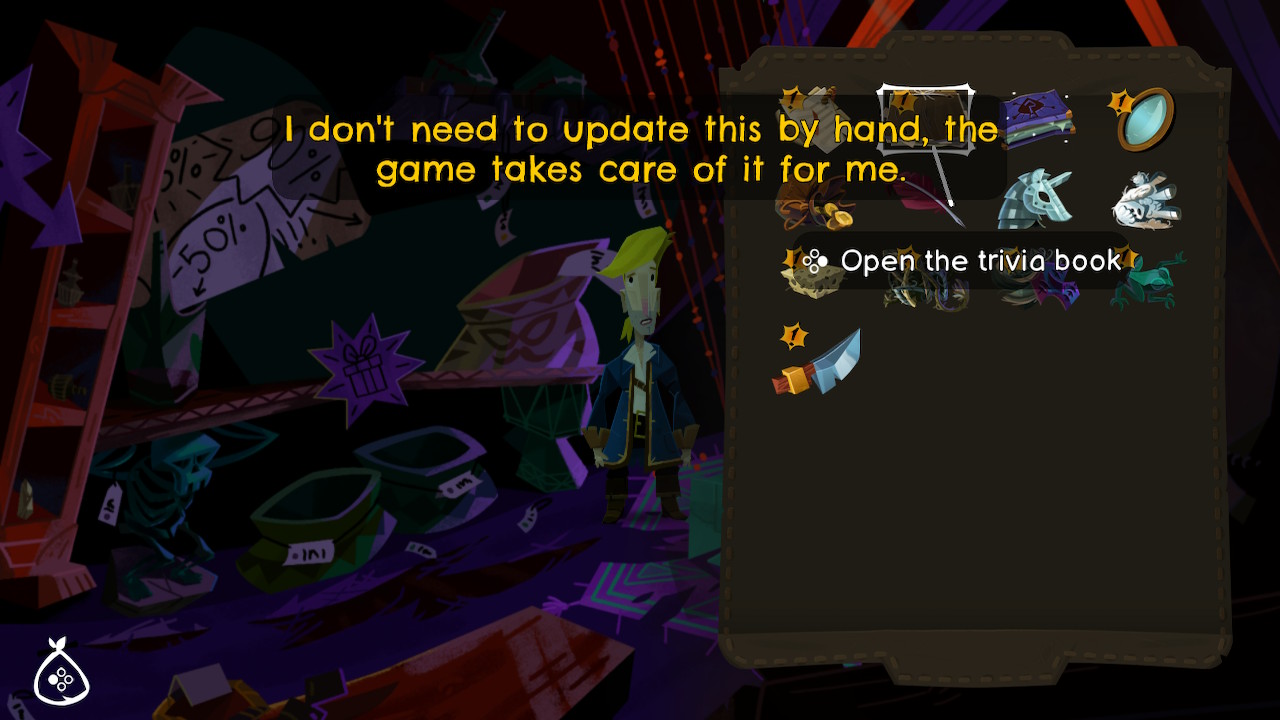
Even if, like me, you are mostly unfamiliar with the Monkey Island games, Return is a perfect entry point into the series. There is a scrapbook on the menu screen that provides a voiced recap of Threepwood’s previous adventures if his past voyages pique your curiosity. The story itself, however, does not require past knowledge of previous games to understand Threepwood’s world…unless you want to try your hand at the trivia cards.  

Just one golden nugget...out of many. (Pst! He's Describing the Quill!)—Captured on Switch (Docked Mode) 

Question: How does the gameplay far on this Return to Monkey Island? Answer: Smoothly. 

You can use either the touchscreen or the controller to guide Guybrush Threepwood on his journey back to the namesake island with little trouble. It does feel slightly more awkward with the controller—as in, I sometimes found myself missing important items in a room—but the game’s use of the top-shoulder buttons makes this a non-issue, allowing you to cycle through every highlighted object until you find the one you need. 

Outside my minor fumble, everything else about the gameplay and the interface is truly a matter of pick-up-and-play. Or rather, in this case: Pick up, discover, and explore. There is also a hint book you obtain early in the game which, when a puzzle completely stumps you, provides a couple of lines to prod you in the right direction. 

Speaking of puzzles, the difficulty modes do a good job of providing the player with the choice between smooth-sailing for the story (casual) and a full-on head-scratcher (hard). If you went from a casual playthrough to the more difficult one like I did, your interpretation of “full-on head-scratcher” may vary since the more challenging puzzles mostly just stick some extra bits and steps on the older ones.    

There is also a neat little option that acts as a sort of “director’s cut” to the in-game dialog—ideally extending the writing. I say ideally since I also started my hard mode playthrough with the option turned on so its a little unclear how it works. That bit of mess is on me though.

No, Not the Artwork...I personally dig it—Captured on Switch (Docked Mode)

The love Ron Gilbert and his team have for the Monkey Island series emanates in every detail of this unexpected installment. Return to Monkey Island is not just catering to long-time fans of the series, but to newcomers like myself who want to join Threepwood’s journey to possible riches. Unless you are a trivia buff or have a heap of Monkey Island nostalgia, this game perfectly stands alone with every character being memorable in both a loving and comedic way. What was simple in point-and-click gameplay is made simpler in controls, but the puzzle difficulty is left up to you. Spoiling this game further would be a disservice as it is an experience full of heart, japes, and barrels stuffed with grog and limes. In other words, I would set sail and make the pilgrimage to Monkey Island if I were you. 

In Sum: The Secret is a glass of grog, rich in flavor and easy to pick up. It is a tale that does not require multiple nights at the bar listening to stories and sea shanties past. If it was a wine, it aged gracefully and will never pixelate: 9.5 out of 10 

Additional Notes: As I'm writing this, there's an ongoing Kickstarter campaign for a book detailing the history of the Monkey Island games from French book publisher, Third Editions. Simply titled The Mysteries of Monkey Island, the book dives deep into the worlds of both Guybrush Threepwood and the team who created the games themselves. It goes without saying that it's not sponsored, but when I went to change my pledge for another campaign (the one for Fusion Retro Books's Annuals), this one popped up in my suggestions. After my experience on Monkey Island, I couldn't say no...

If you're interested in backing it, the campaign ends on October 17th at 11am (EDT).

03 October, 2022

Eventually, I'm Going to Assess the Return to Monkey Island...

Admittedly, this was also my state of mind over the weekend—Captured on Switch (Handheld Mode)

The staycation's over, the weekend's through, and there's no review to be seen...yet. I'm more or less writing this to let you know that there will be a review of the game this week—ideally Wednesday or Thursday at the latest.

I have a proper excuse this time though...

In short, I celebrated another year of aging on Friday and it was a good day! No major celebrations to report, but I did end up putting my expedition into Return's hard mode until Sunday evening. 

Still, it was a good weekend and I made good progress into said expedition. I'll be back soon with the proper assessment once my notes and ingredients are in order.